1.13.2011

EZG reviews Cavalier's Creed & Incantations

Hey everybody, it Endzeitgeist again and this time, I'm taking a look at one of ODs advanced feat books (the only one I own to this date) as well as at Zombie Sky Press's Incantations! I hope you'll enjoy the reviews.


Advanced Feats: The Cavalier's Creed

This pdf is 16 pages, 1 page front cover, 1 page editorial + ToC, 1 page advertisement and 1 page SRD.

That leaves 12 pages of content and starts with 1.5 pages of analysis of the cavalier class, detailing potential strengths and giving a nice overview.

After that, we get 30 new feats, including Teamworkfeats.

-Back to back: Fight with ally, deny flanks

-Barreling Overrun: Overrun more enemies

-Bloody Banner: Inspires allies

-Bravery: Fear and panic are treated as shaken

-Buckler Master: better at using Bucklers

-Campaigner: Sleep anywhere

-Clever Critter: Smarter than other animals

-Defensive Sunder: Sunder incoming attacks

-Extra Cohort: self-explanatory

-Fortune: 1 reroll per day

-Great leader: Leadershipbonus

-Intimidating Gaze: Demoralize foes

-Moral Chameleon: Change orders, retain some abilities

-Move as one: Move when rider does

-Near and far: Reach weapons to attack adjacent foes

-Nimble Mount: Keep rider out of harm's way

-Pack Attack: Flank when allies flank

-Pierce Armor: Bonus to hit armored enemies

-Provoke: self-explanatory

-Pull Blow: Reduce damage after rolling

-Rampage: Continue charge after dropping foe

-Rank Fighting: Cuts penalties for attacking through allies

-Reflexive Brace: Brace faster

-Shaft and Shield: Wield two-handed spears in one hand

-Shielded Move: No AoO from chosen opponent

-Shield Evasion: limited evasion when using a shield

-Size doesn't matter: Ignore size penalties to intimidate

-Strength in Numbers: Better resist are effects when with allies

-Tag Team Flanking: Allies gain bonuses against enemies you hurt

-Team Initiative: you and your allies share the best initiative roll

All of the feats were either interesting, good ideas and more importantly, none seemed too weak or too strong. They also come with commentaries on the design decision as well as some nice bits of historical trivia, which provide an additional insight in both the design process and a like the frosting on the cake. In the rare cases (e.g. provoke), where I would have disliked a given feat, it's mechanics are specifically worded so the DM can prevent abuse.

After that, we get 3 sample builds for cavaliers: The green knight, the tawny knight and the black knight. I liked the builds and their explanations.

Conclusion:

Formatting and editing are top-notch, I didn't notice any mistakes. The feats were often imaginative, cool, fit their niche and felt neither under- nor overpowered. This is quite simply a great feat book (and my standards for them are very high!) and worth the few bucks it costs. Due to the high quality and the low price, I'll settle for a 5 Rudii-rating.


Incantations in Theory and Practice


This pdf is 9 pages, 1 page front cover /including a piece of b/w artwork and text, 1/3 page SRD and 1/3 page editorial, leaving approximately 7 and 1/3 pages of content.

Everybody who knows me from the boards I attend and the posts that I post, knows one thing: While I love the modularity of D&D's 3rd edition and its children like Pathfinder, I hate the way they usually treat magic items and I'm somewhat baffled by all the rules-crunching people do to build killer spell-casters. While I don't judge any of you, I was always wondering: Where is the MAGIC, where has the wonder of magic abilities and with it, the reason for the in-game perceived arrogance of the mighty wizards gone? Has magic, one of the most significant, defining factors of any given campaign, deteriorated into a predictable, boring force that just makes it easier for casters to dominate non-casters at higher levels?

Nope. This is where this pdf comes in. Ever wondered how non-castes use those nifty little curses, rituals and other tools to utterly screw the lives of other people? How and why their rituals entail a sacrifice they are loathe to pay and try to avoid? What the potential consequences of their failure might be?

For an almost ridiculously low price, you can have all these questions answered, at least crunch-wise, for you campaign. I'm not kidding. If you, as a D_M, EVER wanted to bring the sheer aspect of wonder of magic back to your campaign this is the way to do it.

On a crunch note: What are Incantations? They are essentially skill-based, potentially co-operate rituals, complete with backlash, guidelines to use minor rituals and duplicate major magical effects. They ROCK! Your expert-mayor wants to curse the lvl 14 Wizard? There you go!

You'll get all the DCs, modifier and the rest to make your own incantations. You even get 3 samples, previously unreleased incantations to both be examples of what could be done with the mechanics and help you design more.

Conclusion:

I love the concept. I love the execution. I love the price. Zombie Sky Press has done it. This file has the potential to change your approach to PFRPG, hell it has the potential to change your approach to roleplaying and the aspect of magic in d20-based systems. Editing and formatting are top-notch, I didn't notice any mistakes. The one piece of b/w-artwork is kind of cool. How do you rate a file that brought ritualistic magic, complex curses and all-out-non-spell-casting-class adventure seeds as well as an as of yet unperceived variety of hooks to your campaign?

Simple: With the best possible score: 5 out of 5 and the Endzeitgeist-seal of approval. These mechanics should be standard rules, are made of (*internet slang*) awesome and win (/*internet slang*) and quite frankly should be part of just about any DM's campaign if (s)he wishes to give either his/her players an extra edge or the possibility to marvel at the potential usages of magic.


Incantations from the Other Side: Spirit Magic
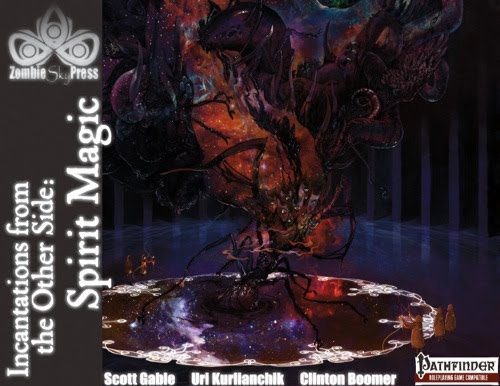


This pdf is 39 pages long, 1 page front cover, 1 page editorial, 1 page ToC, 1 page containing both SRD and Index. That leaves 35 pages of content.

Incantations kicks off with an introduction to the spirit world, explaining how spirit magic and incantations are neither truly divine nor arcane, how they represent a primal power that can be tapped via rituals by anyone who knows how to do so, but may exact a price. (2 pages)

The first chapter describes Incantations from the general area of Vodou. It introduces the concepts of rado, petro and guede Loa which are not bluntly described as the traditional alignments but rather differences in the temperament of the more or less amoral Loa. We get 7 Rada Loa, 5 Petro Loa and 8 Guede Loa in this chapter. Apart from several nice incantations we also get a new disease in this chapter. My favorite incantation makes it possible to literally shed ones skin and temporarily become a incorporeal form, including attacks etc. (12 pages)

The second chapter details the so-called Middle World, inspired by Slavic mythology. We get 6 spirits and a sidebox with two great ideas spawned from mythology about spirits and 8 incantations. They have a completely different feeling from the first chapter and make EXCELLENT additions to e.g. a "Tales of the Old Margreve" or otherwise Slavic-inspired setting.(12 pages)

The final chapter details the Arcanum and its utterly alien, slightly Lovecraftian patrons from beyond the stars and contains 4 quite complex incantations as well as a sample lodge and 5 sample patrons.(9 pages)

Conclusion:

Editing and formatting are top-notch, the pdf comes in full color and is a beauty to behold, complete with nice artwork and its own distinct style. However, it will test the mettle of your printer and a printer-friendly version would have been very much appreciated. With regards to the content, I can only say: WOW. I've always somehow disliked the fact that magic has become a more or less predictable commodity in RPGs and, while I always understood the necessity of predictable systems, this little file adds one stable of fantasy literature and mythology I always missed: The powerful, cool rituals and negotiations with other entities, the underdog non-caster somehow cursing his opponent. The wise woman beseeching the spirits of nature etc. - without being druids, mages etc., has too long been absent from our favorite systems and these incantations are not only expertly written, make great hooks for adventures and put the awe and unpredictability back into magic, they are also plain fun, creepy and/or cool to read. If this pdf does not inspire you to write an adventure, I don't know what will. The system is elegant, concise and should be included in the standard PFRPG-canon. My only two gripes are: I want a sequel, a whole book of incantations and I want a printer-friendly version. Content-wise, this is a straight 5-Rudii-file, but be aware of the lack of a printer-friendly version. If that's a problem for you, subtract a Rudi. My final verdict will thus be 4.5 Rudii.


That's it for now, folks. Thanks for reading my ramblings,

Endzeitgeist out.

1.05.2011

Psionics Unleashed

Psionics Unleashed by Dreamscarred Press

This product is 231 pages long. It starts with a cover, credits, and ToC. (5 pages)

*Note – (I wanted to point out, I was never a huge fan of Psionics, I was given this product for the purpose of this review. I have nothing against Psioncis they was just never my thing. So I am writing this review from the point of view of someone who is coming in that is new to psionics.)

Introduction (2 pages)
This gets into what Psionics are, about their powers, over all chapter breakdown, changes made and why, it ends with a message from the two main authors of the book, talking about the project.

Chapter 1 – Races (12 pages)
This section has 8 new races, who are all psionicly adept. It lists full information about them. From game mechanics, society, description, relations to other races and Psionic Aptitude.(special things they get when taking their favored class) Below is a list of the new races and brief overview.
Blue – a goblin race.
Dromite – Halfling sized insect people.
Duergar – you know what they are, dwarves.
Elan – created race, chosen from other races and transformed.
Half-giant – They sound more like a new race of giants though they are supposed half fire giant but it doesn't really say or imply what other half they are, I suppose human.
Maenad – More or less a new ethnic group of humans.
Ophiduan – a reptilian based race.
Xeph – a new race that looks fairly human.

Chapter 2 – Classes (18 pages)
This section has 4 new base classes. It has a section about how to update your old classes to the new versions, a section on multi-classing, and power points. After this it gets into each of the new classes. I copied a bit of the book below to give a bit about each class.
Psion: A master of the mind, a seeker of knowledge of psionics. - More or less the equal of a full caster class. Low BaB, hp etc. They have six disciplines to choose from, sorta like magic schools in a way.
Psychic Warrior: A soldier who combines psionic power with physical prowess. - To me it seemed to be more like a self buffing bard that fights. They gain warriors paths, abilities to do special things based on the theme of the path.
Soulknife: A warrior who creates a unique weapon out of mental energy. - This one is a bit hard to explain, it is a light armored fighter that uses their mind to create weapons to attack with. Other than just giving their mental energy weapon bonuses they can also give them special abilities, such as shocking, holy, keen etc.
Wilder: A natural talent with psionics who channels emotion to wield uncontrolled power. - There is really no class or roll they are really like. They have great power but limited control.

Chapter 3 – Skills and Feats (18 pages)
This talks about any skill that works different, or in the case of spellcraft how it is used for psionic power checks etc. The choose to condense the skill list to fit pathfinder and mesh psionics and magic more. Use magic device is used for magic and psionic devices for example. Some might not like these changes, me I do. That was always one of my issues with psionics before. It does the same thing with feats, such as magic item creation feats, what types of psionic items can be created with the feat. There is also 69 new psionic based feats, to many to list honestly but all of them seemed on par with existing feats.

Chapter 4 – Psionics (14 pages)
This section gets into how powers work, saves, costs, adding powers, resistance(which like other stuff is now the same as Spell Resistance, a monster with one has the same for both), how to use psionics in your games, variant rules so psionics and magic don't overlap. Basically a overview of how the powers work and how to use them in your campaign.

Chapter 5 – Powers (86 pages)
This has the power lists for the classes. Followed by the write up of each of the powers. There is about 290 powers in the book. Some copy the effects of existing spells(to a point), while others are totally new.

Chapter 6 - Prestige Classes (20 pages)
This section deals with new prestige classes for the psionic base classes or non-psionic base classes to take. There is 9 new PrC's in this section.
Cerebremancer: A practitioner of both arcane magic and psionic power, wielding both efficiently. - Combines psionic powers with arcane spells.
Elocater: A master of altering gravity and space, performing seemingly impossible maneuvers. - any martial class and psionic class could work.
Metamind: A manifester who sacrifices his expertise with higher level abilities to expand his reservoir of power.
Phrenic Slayer: A hunter of a type of psionic creature who gains abilities to aid in the chase. - Can work with any melee class and psionic class, but ranger seems to fit best.
Psion Uncarnate: A manifester who has left the need for a physical body behind.
Psychic Fist: A monk who uses his innate psionic ability to augment his martial prowess. - Seems like a good soul knife/monk combo.
Pyrokineticist: A wielder of flame, sending bolts of fire at enemies and using their body heat to heal.
Thrallherd: A manifester who puts out a psionic call for thralls and believers. - a PrC that focuses on controlling the minds of others.
Warmind: A devastating warrior who learns many secret combat techniques.

Chapter 7 – Psionic Items (28 pages)
How to use psionic items. More or less they are similar to how magic items already exist in the game. It does have some psionic effects of their own and a good list of psionic premade items.

Chapter 8 – Psionic Monsters (25 pages)
There is 20 monsters in this section, with a couple having more than one variation like the construct.

Glossary (2 pages)
This explains all the terms used in the book and what they mean.

It ends with a OGL and ad. (2 pages)

Closing thoughts. As I mentioned at the start I was never a fan of psionics, I had nothing against them. I just felt they never added enough, for the work required to add a new total system to the game. With this book combining a lot of the aspects like use of skills, resistances etc that in my honest opinion makes psionics a lot easier to adapt into more traditional games. The writing was good and I didn't notice any major errors, it was fairly easy to understand for a newbie just get into it. The layout was decent but there was a few spots where there was some wasted space, end of the feats chapter was a big one. A single feat on a otherwise blank page.

The art ranged wildly, some was color, some was black and white. Some was cartoony and other more traditional. The quality also wildly ranged as well. I honestly found the art to be a let down. It wasn't the quality but the clashing styles was more of a problem for me. This book basically takes the existing psionic rules and updates them to Pathfinder rules and meshes them much better with the game in my opinion. I think these rules as someone who was not a fan of psionics before to be a vast improvement over the old rules. Enough so that I for the first time in a very long time, will experiment with using them in my games again. To see how it goes. I am not ready to let them fully in, but the book did a good enough job that I will sprinkle them in and see how it goes.

The feats, powers, classes etc. They all seem well written and well balanced against the existing Pathfinder core rules. I didn't find anything overly powerful or overly weak. I am unsure how it stacks up with the previous books as I only have passing knowledge with the 3.5 psionic rules. My main issues with the book was clashing art styles and I thought the layout could have been done better. So whats my rating? I find this one hard to rate since I think it depends if you was already a fan of psionics or not. Personally I am giving it a 4 star review from my point of view. For fans of psionics that want something for their Pathfinder game I think you will be very pleased. For those that thought psionics had issues before but was not dead seat against them, you might want to check the book out, it might just change your mind. If you was one of those that just hate the idea of psionics in fantasy, well I don't think this book will change your mind.

1.03.2011

EZG reviews Evocative City Sites

Hey everybody, happy new year! I hope you had a great time and look forward to 2011!

I know I'm late, but to make up for it, I'll review some Evocative City Sites. Without further ado: Let's go!


Voell's Garden

This pdf is 27 pages long, 1 page front cover, 1 page editorial, 2 pages advertisements, 1 page SRD, leaving 22 pages of content.

The pdf starts with 1 page containing the whole map of Voell's Graden and then dives into the in-character introduction to Voell's Garden, interspread with 5 detailed maps of the respective parts of Voell's Graden. The chapter also details secrests, a table for strange flora, notes on how to use the garden as a maze and secrets for the characters and garden. We also get a new poison and 5 adventure hooks. This passage is 8 pages long.

The next chapter details 6 pages of statblocks of the inhabitants, once again at the top-level of complexity, one of which is a potentially legendary and extremely cool and disturbing...thing that clocks in at a whopping CR 24.

The pdf closes with 7 pages of reprints of the maps as well as 7 separate maps of the garden in A4 format for Europeans like yours truly.

Conclusion:

Editing and formatting are top-notch, I didn't notice any mistakes/glitches.

I don't know why, but sometimes, if presented right, plants can creep the hell out of me, and I consider myself to be quite a jaded guy. Voell's Garden features some of the most enticing writing I've read in an rpg-book, especially in such a small one and really had me on the edge of my seat. For fans of the series it also features a slight nod towards Bedlam Asylum.

The statblocks rock, as almost always in the ECS-series and the final critter presented is cool as hell. However, as much as I want to, I can't bring myself to rate this 5 Rudii. This is due to two facts: The file does not have the usual blown-up versions for use with miniatures the other ECS-files always featured and, once again, the bane of my existence is back - the maps feature letters and a legend, detracting for me from the player's suspension of disbelief and preventing me from printing it out for my players. I don't get why the combined map e.g. has to feature the letters. That being said, the writing somewhat made up for this and my final verdict will be 4 Rudii - if you don't mind letters in your maps or need the miniature-friendly huge maps, add a Rudii.


Clock Tower

This pdf is 41 pages long, 1 page front cover, 1 page editorial, 1 page SRD, 2 pages advertisement. That leaves 37 pages of content.

The makeup of the clock tower containing separate, beautiful maps for each of the 4 floors takes up 7 pages and starts with a nice in-character introduction that runs, intermixed with some mechanics, throughout the whole chapter, making this a very enjoyable read, especially if you're into the central topic of this installment of ECS: Time and a clock tower moving backwards through it.

There are also several cool ideas to set the mood of the clock tower, including tables for random time events in RP and in combat. The description also includes a whopping 5 boxes of secrets and 6 adventure hooks.

We also get 3 new NPCs, a new magic item as well as a new kind of monster. (5 pages) While the statblocks are complex, they are not as extremely complex as some others from the ECS series - the characters are still extremely cool and I liked them all.

The pdf closes with 26 pages of blown-up maps for use with miniatures. It should be noted, that map keys, the bane of my existence as a DM, have mercifully been both left out and are not necessary due to the high quality and nice drawings of the maps.

The pdf also comes with 4 files à 6 pages containing the maps in scale for miniatures in A4 format for Europeans like yours truly.

Conclusion:

I'm a sucker for time travel, time paradox, chronomancy etc. - problem is, most publication, be them novels, games or movies are doing it wrong, big time. This one does it Rite. (Hitting myself for the bad pun right now...Ouch!) Both the fluff and the crunch are cool, the maps are up to RiP's high quality standards and editing and formating are quite good - the only glitch I noticed was that in the bookmarks you can see question marks instead of hyphens. I also liked the NPCs, albeit I would have loved to see something more complex done with the final one. So, what's my final verdict? For the very low price, you get an excellent installment of the series. Personally, the chronomancy-aspect weighs up with my minor points of criticism, resulting in a five Rudii file. If you're not that into time travel and its concepts, detract half a Rudi.


Next time, I'm going to take a look at some stuff by Open Design and Zombie Sky Press, see you then! (And yes, still writing two monstrously large reviews...)
As always, thank you for reading my ramblings,
Endzeitgeist out.


12.31.2010

Cerulean Seas

Cerulean Seas by Alluria Publishing

This product is 290 pages long. It starts with a cover, credits, and ToC. (4 pages)

Chapter 1 – Undersea Basics (22 pages)
It starts with a IC introduction explaining what has happened and why 99% of the world is covered in water now. It moves onto a OOC explaining how and why the book was made, followed with advice on using it and common terms in the book. Next it gets into the environments of the sea. The different zones in the ocean, close to land, far from it. How deep one is from the surface, including how much light there is, the effects of the tides etc It gets very in depth and covers everything very well.

Next they get into buoyancy, it goes into great deal of the effects this has on characters and creatures under the sea. It also gets into drag effects of pulling a object or person along underwater. Followed by the effects of pressure has on living things. Next is current's riptides, and undertow, swimming speeds, terrain above water and at the bottom of the ocean. I don't know how realistic all of it is, but it is well written and seems like it would work very well and makes sense.

Next it gets into perils like poisons, diseases, blood in the water drawing sharks, water conditions like murk or whirlpools etc. It ends with a short section on undersea combat, with some differences. Like it being a 3D environment.

Chapter 2 – Undersea Races (20 pages)
This chapter details the undersea races one can play in a undersea campaign. They are all done in enough depth and detail to easily pick one up and start playing with them, giving you everything you need just like the main races in Pathfinder core rule book. The are broken up be species type and then by individual race. It finishes with a whole host of half bread combinations. Since many of them are egg laying races it is far easy to get cross breeding as any male can fertilize the eggs.
Anthromorphs
-Karkanaks
-Mogogols
-Pisceans
-Sebek-kas
Feykith
-Elves, Sea
-Naiads, Viridian
-Nixies, Deepwater
-Selkies, Lochgelly
Merfolk
-Cindarians
-Kai-lios
-Nommos
-Seafolk

Chapter 3 – Undersea Classes (34 pages)
At first it talks about how you can adapt the existing Pathfinder classes to use in the game, including the APG classes. Some are pretty minor changes some are a bit more complex. It also introduces two more domains, undersea Flora and Steam domains. It also has a table of 27 deities, domains weapons etc, more details in chapter 7. The druid has 18 new animal companion options. There is several new Eidolon evolutions to choose from. Plus 12 more familiars for the witch and wizard.

Next it introduces three new classes. They replace the niche of some of the existing classes in new and interesting ways. There is nothing stopping you from using both classes in the same game though.
Kahuna – replaces the Druid
Mariner – replaces the ranger
Siren – replaces the Bard

Next it gets into PrC's and which ones fit and what you need to change if anything and the ones that don't. It also includes three new PrC's as well.
Beach Comber – They go up on some of the little land left and spend time there.
Glimmerkeepers – Honestly to hard to explain but very cool.
SeaWitch – a PrC for the new Siren class.

Chapter 4 – Aquatic Skills and Feats (14 pages)
It starts off talking about all the skills that are different and how they are different. Next it moves onto existing feats that need to be tweaked and what they do now to fit. Next it introduces 45 new undersea flavored feats that all fit very well.

Chapter 5 – Money and Equipment (20 pages)
First it gets into the new money system, since most metals tarnish or rust underwater it makes sense. They use small shells, gold, pearls and such. Now on the shells they really should have made it clear they had to have stamps to make them valuable or people could just go kill the creatures and take their shells for money.

It follows this with a section on weapons, armor and undersea gears. There is simply way to much to list or even high light. They did a good job with the gear for the most part. Other than a few minor issues like Spiked Chain which honestly just would not work underwater. It even has a section on sailing ships. There is several new weapons, armor and a couple of dozen new gear items, not to mention many of the old stuff tweaked to fit the setting.

Chapter 6 – Magic of the Sea (34 pages)
It starts off talking about how spells will work differently underwater. It is followed by a table of aquatic material components in place of the existing ones. I thought that was very cool as some stuff just wouldn't exist underwater. Next it has a chart of spells and their new names, while not needed it was very cool and makes sense. I mean no one would call a fireball and fireball underwater, instead it is mageboil as it makes the water boil instead.

Next it details all the new spells and spells that have changed such as fireball to mageboil. I tried counting but I lost count. There is around a 120-130 spells, I am honestly unsure how many are new and how many are altered. At a glance I would say close to 50/50. It ends with 9 new magic items and a few new magic item properties.

Chapter 7 – The Cerulean Seas (25 pages)
This section gets into the campaign setting, it has the gods, cities, etc, it is a campaign gazetteer for the default setting of the book.

Chapter 8 – Mastering the Sea (10 pages)
This is the game master section of the book on how to run games underwater. It gets into greater detail of some of the previous stuff like buoyancy etc. About how to find depth tolerances for creatures, by what they are. The most interesting section is on 3D combat and how to make your own 3d combat mat to use with mini's if you like. It ends with a section on how the planes interact with the sea.

Chapter 9 – Cerulean Sea Bestiary (72 pages)
This chapter is just a monster bestiary for the setting but also a great one for anyone that ever wants to run a undersea adventure. There is 95 new monsters including new sound based dragons which all looked different and where really interesting. Many had more than one stat block like the dragons. There was also 5 new templates.

Appendices (6 pages)
There is a few Appendix in this section, monsters listed by CR, pronunciation guide, index of tables and index of art.

It ends with a OGL, 2 page character sheet, 4 cardboard mini's, hex sheets to make the 3D battle map with, a full page map, indepth index and back cover. (17 pages)

Closing thoughts. This is a very well written, very pretty book about undersea campaigns. The art work is mostly color and very good high quality art. The editing, layout and production values was top notch. Simply put if you ever wanted a book to help you run a undersea campaign THIS is the book to get. Even if you don't want to, this would be a great tool if you ever wanted to just run some adventures underwater.

Now the book is not perfect, there is a few minor issues where and there with it, like the spiked chain or the shells I mentioned. But most of them are pretty minor issues. My only real critic is honestly the price. I understand Alluria publishing is a small company and art is very expensive, after seeing the art in this book I am sure they spent a bundle on the art budget. But it is a bit high priced at 29.99 for a PDF. If that was the print price I would say fair price, for a PDF though? I felt a tad high. So whats my rating? Well just on the book it is easily a 5 star product, with the price I would say a 4.5 star. I know the price is a little high but I don't think you will be disappointed picking this up, if you find undersea adventures interesting at all.


12.29.2010

EZG reviews Legendary Blades and goes 4th Dimension

Hey everybody,

In these closing days of 2010 I thought I'd post some reviews for your perusal - without further ado: Enjoy!

Legendary Blades


This pdf is 42 pages long, 1 page front cover/editorial/ToC, 4 pages SRD and 1 page of thanks for the feedback. That leaves 36 pages of content for $3.00! That is an awesome bang-for-buck-ratio. Now let’s take a look at whether the content suffers from the low price.

The pdf kicks off with a one-page introduction on how legendary weapons work and adds a variant optional rule for weapon jealousy. Nice.

The weapons follow a two-page format including b/w-artwork, requirements of the weapon, all the abilities and a table listing the weapon’s progression. The weapons are:

-Alieywishia, Orc Scourge: A bane curved scimitar-like weapon that helps slay and track Orcs.

-Asterion’s Soul: A brutal sword inhabited by the sould of a minotaur.

-Counter: A cool main-gauche for duelants.

-Crusader’s Sword: A holy consecrated blade for clerics, paladins and Inquisitors to kill evil outsiders.

-Diamond’s Edge: An incredibly sharp blade that is said to be connected to the mythic diamond dragons

-Ebon Whispers: A lethal Assassin’s Throwing Dagger

-Endless Winter: Ice-cold blade of a barbarian legend.

-Gladiator’s Response: A showman’s blade to kill beasts etc.

-Guardian: The sword of a heroic last defender.

-Lion of Iskander: A holy sword for the leaders of men.

-Mitra’s Blade: Undead-slaying sun-themed falchion

-Moon’s Vengeance: Anti-Lycanthrope side-sword

-The Red King’s Judgment: A fiery greatsword worthy of a villain (or an anti-hero)

-Sandman’s Blade: Rapier with time-abilities for bards and arcane casters.

-Sorrow: A creepy, tragic sword. One of my favorites.

-Summoner’s Tool: A Summoner’s tool to make his Eidolons stronger.

After that, we get one page with two alignment templates and a new combat maneuver: Parry. We also get another two pages containing three new feats and three new spells.

Conclusion: Editing and formatting are top-notch, I didn’t notice any typos or the like. The writing and prose are concise and do a great job of making the blades interesting in spite of the limitations in space and the setting-neutral background.

For the very low price, you get excellent blades and a HUGE amount of content. While the abilities could have been a bit more on the far-out side of things for me, I can’t help but like what Mark Gedak and Stefen Styrsky have done here. I love leveling weapons and this file provides them for an extremely fair price. I have high hopes for the sequel. (Which has just been released!) And a file for leveling armors. For now, I’ll rate this a very good 4.5 Rudii due to the fact that I would have loved to see some rather far-out abilities. (Like the Fiery Discorporation of “The Red King’s Judgment…)


Skill Encounters – Non-combat challenges: Basic Rules


This pdf is 21 pages long, 1 page front cover, 1 page ToC/Editorial, 1 page advertisement, 2/3 page SRD. That leaves 17 1/3 pages of gaming content.

You know, I was rather disappointed when I bought and played 4th edition. I don’t say it’s a bad system because it simply isn’t – it works awesome for the thousands of people who enjoy it, it’s just not made for me. However, I absolutely loved the idea of skill-encounters and had been using a similar concept in my home campaign for years. This pdf brings skill-encounters to PFRPG.

The pdf kicks off with three pages that explain how to read a skill-encounter and how to write them.

The first skill challenge presented is the all-time classic, the chase (3 pages). The encounter includes information on how spells affect the encounter, with several complications like quick changes, escapes to sewers and rooftops and the like and results for failures. We also get a sidebar for combat during the chase.

I enjoyed reading this one.

The second skill-challenge is gathering information (4 pages). This one also has a huge one page box detailing contacts (barkeeper, wenches, etc.) for the PCs to ask. I’ve been looking for a pre-made encounter for this as I always hated the generic “One-roll-you get the-info-approach”. Well-made piece.

The third skill-challenge is haggling (2 pages). Due to the nature of the challenge, this one is rather timid and not too suspense-laden, but well done nevertheless.

The fourth skill-challenge is research (3 pages). This is probably one of the coolest skill-challenges within this book – at least for me. If you happen to have an investigation-heavy campaign, this section alone is worth the price. The complications like other scholars, library holidays and the like are both generic and cool. Nice work.

The fifth and final skill-challenge is wilderness travel (2 1/3 pages). While the default is a forest here, we get a sidebar on other terrains and how to implement the complications presented. Another great skill-encounter.

Conclusion:

I really love skill-encounters, if only because they give PCs a chance to roll the bones and build suspense without resorting to bashing. Thus, this pdf has a rather easy standing with me. Especially the gather information, research and chase encounters are gold for my campaign. The pdf itself is beautiful and full-color, the artwork is okay and presentation is concise and precise in its wording. I didn’t notice any editing glitches. However, there are also some drawbacks that I feel I have to mention: While the pdf is beautiful, the page are yellow and there is no printer-friendly version out there.

While the pdf is not large, I think it would have benefited from a printer-friendly version, as b/w print-out it just doesn’t look as great. I also would have loved to see bookmarks, as there are none. In the haggling section, I missed a complication for another bidder for the item. The pdf is priced $5.00, which is ok for the quality, but not too cheap.

It’s quite hard for me to rate this pdf: On the one hand, I LOVE skill-encounters and that they have been brought to PFRPG and the utility of this product. On the other hand, I have these minor criticisms and thus can’t rate it 5 Rudii. I’ll shoot for a very good 4.5 Rudii instead, with the notice that, if you don’t care about the yellow pages or the lack of a competing haggler, this is a must-buy for you. These rules should be part of the standard Pathfinder canon. Here’s to hoping Paizo will implement them.


Skill Encounters: Deadly Challenges – Traps


This pdf is 24 pages long, 1 page front cover, 1 page editorial/ToC, 1 page SRD and one page advertisement. That leaves 20 pages of content.

The pdf starts with a short chapter explaining skill encounters and how to run them. (5 pages)

After that, we get the first encounter/trap. Before I get into reviewing this product, I have to admit something: I love traps and I hate how they are treated most of the time: The rogue goes ahead, tries to disarm it and there we go – one roll while the rest of the PCs waits for the rogue to do his job or die trying. This little pdf introduces traps that have something for the whole group to do and can’t be overcome with one single roll.

That being said, let’s delve into the first encounter, the classic vicious spike pit. (3 pages) The skill-encounter features two complex sets of checks to deal with the trap: Escape & Disable. Both are fractured in the encounter, spells are dealt with, etc. However, one of the complications e.g. mentioned churning blades, which aren’t factored into the stats of the trap, somewhat rendering them a bit strange. The same goes for exploding spikes. I know that the DM is supposed to scale them, but I nevertheless would have liked that being done for me.

The next trap is the poisonous gas chamber. (4 pages) This encounter features a sample map of the room, including grids and the like. Once again, two ways to solve this are presented, “smash it” and “plug it” – both are interesting, but I personally preferred the complications for plugging it.

The next trap is the sucking vortex. (3 pages) This skill encounter is interesting due to being both individual skill encounters and a group encounter to shut down the vortex as well as a sample map with a grid for the corridor with the vortex. While being an iconic and simple idea, I really loved the presentations and complications of this one. Nothing to gripe about here.

The next challenge is the flooding room. (3 pages) I really did like the encounter, the complications and so on. However, I’d have loved to see a twofold variation here: One mechanical trap and one magical flooding room – they also would have made a great combination trap.

The final trap derived from a tried and true statement in gaming, the classic “Rocks fall, all die.” – The last skill encounter is the collapsing dungeon! (3 pages) This skill encounter is by far my favorite among the ones presented – not only because it is iconic and cool, but also because it is lethal, it’s mechanics are simple, yet interesting and due to an added “Buried!”-mini skill encounter.

Conclusion:

As I’ve already admitted in my first skill encounters review, I’m a sucker for them: I e.g. immensely enjoyed the collapsing dungeon and the vortex. However, there are still some minor problems with this pdf: While the artwork is ok and the whole file is full color, I would have loved to see a printer-friendly version without the yellow background and with less pictures and more mechanics – both with the poisonous gas chamber and the flood chamber, I think that we could have had more complications/ideas instead of pieces of artwork. Editing and formatting is concise and makes running the encounters easy. I’d really like to give this a full five Rudii, but some of the skill encounters made me want more out of them or just didn’t strike me as too interesting. Combine that with the lack of a printer-friendly version and I’ll settle for a good 4 Rudii rating. I really hope to one day see a massive tome of skill encounter traps, with more exotic and far-out traps intermixed with the new take on classics. If you’re a DM who is sick and tired of the one-die-roll-trap, be sure to give this a try, you probably won’t regret it.


Alright, as in the classic Warner Bros. cartoons, "That's it, folks!" - at least for 2010. I hope to be of assistance in 2011 again and wish you all the best for the new year! Thanks for reading my reviews, talking to me online, your feedback, etc.pp. - I'm doing this for you guys and without you, I would have never written so much. A special thanks to all the great people I've met during the last couple of months, to the nice designers, to Dark_Mistress for encouraging me to picking "serious" reviewing up and to Lou for offering me this blog to post my reviews as well as for encouraging me to write reviews in the first place. My thoughts go out to all of you, wherever on this blue globe of ours you may be located - Here's to a great 2011!

As always, Endzeitgeist out.


P.S.: Next year: Some big reviews that took FOREVER to write. :)