

 Posts


RPGAggression reviewer Endzeitgeist's compilation of reviews on all of Rite Publishing's race books garnered some attention. Not least from Steve Russel, president and publisher over at Rite. By way of saying thanks, Steve is kindly offering two discounts to RPGAggression readers:
Bundle of all the Rite races for $13.96 (normally $19.95), and
30% off In the Company of Gargoyles $2.79 (normally $3.99)
Just for us and thanks to Endzeitgeist's busy pen. Enjoy!
Lou Agresta
10.07.2010


10.05.2010
Endzeitgeist reviews Coliseum Morpheuon

Disclaimer:
I've been a part of this patronage project and have contributed some minor pieces to it. This review takes a look at the pdf version as the print version has not yet been released. If the print version is somewhat different from the pdf, I'm going to edit and expand my review accordingly.
The pdf is a whopping 127 pages long, 1 page front cover, 1 page back cover, 1 page editorial, 1page OGL. That leaves us with 123 pages.
A quick glance at the cover and interior shows you that CM is a full-color book, and a beautiful one at that – both the full-color artworks and the formatting is beautiful to behold and easy to read. That being said, let's jump into the fray.
The pdf kicks off with an informative introduction on the subject matter of the plane of dreams in literature and gaming that serves to provide both nice recommended readings as well as lead into the first chapter.
Chapter 1: The Plane of Dreams (4 pages) – This chapter has some information on the plane of dreams, e.g. how to temporarily change gravity, the altered effects of the dream spell as well as 5 sub-regions of the plane of dreams, all evocatively written and full of possible adventure seeds. I especially enjoyed some subtle nods to Lovecraft in The Ghoulish Cliffs and the disturbing nature of the Idle Isles of Daydream, where one may literally dream one's life away.
Chapter 2: Dreamburning (5 pages, one of which is an artwork of the spell Dream Stealing in action) – Dreams are power in the plane and subsequently three levels of personal dreams are introduced: Hopes, Aspirations and Goals. These three are determined via 3 simple questionsif you don't want to design tailor-made questions to determine goals, hopes and aspirations of the PCs or need some guidance. Why use dreams, you ask?
Well, you might burn dreams to gain all sorts of benefits and the practice of dream-burning is simply role-playing gold for any players. Players may even permanently sacrifice their dreams or lose them – as everyone knows who ever had one of his/her dreams squashed, a significant loss. Being presented mostly mechanically, we also get the influences of high-level magic like limited wish and Restoration on degraded and/or destroyed dreams. Plus, we get an interesting moral choice: Via the destruction of other people's dreams, one may regain a lost dream – this being, of course, an evil act shoots close to home is a hard choice and somewhat reminiscent of the choices one may have to face throughout life. Furthermore, we get new dreamburning-related traits that might be converted to feats, Designer's notes (with which I wholeheartedly agree) on the reason for using dreamburning and some additional pieces of advice on how to expand/change or eliminate parts of the rules.
Chapter 3: Denizens of Dream (7 pages) – This chapter kicks off with 2 pages on how the different kinds of creatures are represented on the plane of dreams, what can e.g. be encountered and so on. 4 new monsters are introduced, all of which are cool and have some nice twist or cool ability. Even one of my favorites, the Denizen of Leng, has been upgraded to PFRPG – very nice.
Chapter 4: The Island of the Coliseum Morpheuon (8 pages) – The Island in the plane of dreams that contains the Coliseum is detailed herein in Gazetteer-style and depth: We get notes on the strange society within, on the Pagodas of Patricide, Regicide and Deicide, the Voracious Visitor (a strange, black moon orbiting the Coliseum), adventure seeds for going beyond the Coliseum Morpheuon, more than one page of rumors and seeds to kick off whole campaigns centered on the Coliseum.
Chapter 5: Denizens of the Coliseum (28 pages) –If you're looking for a high-level adversary, this chapter alone is worth the price. Some of the Evocative City Sites – pdfs by Rite Publishing featured extremely complex, cool stat-blocks. This chapter is chock-full with them. But you undoubtedly want some examples, so here you go: We get Auberyon (also known to the Warhammer-crowd as Oberon), master of the wild hunt. His bodyguard is both the hunt and a part of the hunt, a hound-creature that can split up into smaller hounds. (The statblock of Auberyon also features 2 new weapon qualities - several creatures feature new crunchy abilities, but there are too many to mention them all.). We also get adversaries/benefactors like The Dragon of the Ghost-Dance, Lady Puzzledeep, the Witch of Stolen Hopes, several others and also notably The Pasha of the Swirling Ashes whom you can take a look at in the free Rite Review- magazine.
Chapter 6: An Overview of the Epoch (6 pages) – The contest called Damnation Epoch is given an overview for the DM here, including several possible reasons for the PCs to participate in the contest – each and every one sets a different tone for the epoch and thus greatly increasing the replayability of the scenario. We also get short comprehensive summaries of some of the potential benefactors. There are also some other teams of contenders for the DM to develop upon as well as information on how to roleplay the Khan of Nightmares.
After this chapter, we get to the adventure section of the book and thus MAJOR SPOILERS. PLAYERS, PLEASE STOP READING HERE:
Chapter 7: An Invitation to Damnation (11 pages) – How to get your PCs into this adventure? Well, several interesting ideas, from In Medias Res to foreshadowing dreams and the like are given. After the synopsis, we get 5 trials for the PCs to best both with brains and brawl to earn the privilege of participating in the contest itself. This is where all the stops seem to have been pulled – take a look at the cover to see what PCs may witness and cackle with glee. The riddle contest has 3 clues for any given riddle, which is nice for the people who don't enjoy them. This part also features 3 pages of handouts for the players.
Chapter 8: The Tests of the Coliseum Morpheuon (5 pages) – This chapter provides the basic outlines for 34 encounters a DM can use to give life (or in some instances un-life) to some of the denizens of the Coliseum. The encounters also serve to personalize the experience of choosing different benefactors and, once again, increase the replayability-value.
Chapter 9: The Tests of the Damnation Epoch (21 pages) – Herein lie the different tests the PCs will face in the contest “Damnation Epoch” , a contest not only for the lofty price, but also a challenge to preserve one's moral compass within the tests. All of the tests have mechanically very interesting themes and are laden with symbolism: In The Chains of Guilt, the PCs have to bear the chains of their guilt (which get consecutively heavier) up some stairs while defending against the other team in the contest. In another test, one of the PCs becomes a dragon and PCs have to catch rings while riding their comrade through a lightning storm. While I don't want to spoil all of the goodness, let me give two further examples: Ever wanted to put your PCs on a piece of a broken planet that is rapidly falling into the sun? Or battle their way through a WHOLE ARMY to escape the dreaded Tarrasque (or turn around and face the beast)? All of this and more can be found in CM. And that is not even the furious finale.
Chapter 10: Secrets of the Coliseum Morpheuon (5 pages) – This chapter has 6 possible sample campaigns for different benefactors in the Coliseum Morpheuon, including different plot secrets and climaxes, further cementing the potential for several wildly different scenarios in CM.
Appendix 1: The Dirges (8 pages): This chapter contains the extremely cool, undead team that is one of the opposing teams for the PCs.
Appendix 2: The Gray Feathers (5 pages): Written by yours truly, this is another team of adversaries, albeit not one as villainous.
Appendix 3: Pregenerated Characters(5 pages): This contains 4 pregens: 2 Ironborn, 1 Jotun Paragon and 1 Wyrd – all of which are cool races and make nice NSCs, too.
Conclusion:
If there has ever been a premium product, this is one. Granted, it's not cheap, but you do get an awesome product that is, at least in my humble opinion, worthy of an ennie. Formatting and editing is top-notch, wording is concise, I didn't notice any typos or glitches, the full-color artwork is just beautiful and in some cases even on Paizo-level. The prose as well as the crunch is extremely imaginative, chock-full of brilliant ideas and the whole book just oozes creativity, originality and, most important, fun. The plane of dreams and its mutability are fully utilized to provide some awesome battlefields, cosmopolitan (or rather cosmoplanar) encounters, adversaries and allies. Patrons also got a several map packs and paper minis for the opposing teams – I'm not entirely sure whether they are included in this deal or not.
The maximum amount of replayability and the sheer amount of potential ways the whole storyline can be portrayed by the DM with the information contained herein is another major plus for me.
I tried very hard to be nitpicky with this one, I really wanted to find some faults in order to balance this review. The only possible criticisms I could offer would be that some maps are used for more than one encounter and beyond that, (because I'm a sucker for those) that I'd love to have seen a fully written dinner-scene within, not just some guidelines and seeds and ideas for the DM to develop. But that is really looking for dust-motes and scrapes with a microscope.
If you for example liked the adventure in Malhavoc Press' "Hyperconscious", you will LOVE this – it just goes one step further.
If you are looking for a new way to carry your campaign beyond the AP-lvl 15-cap, this is a perfect way to do so.
If you just want to play something completely different, this is for you. If you don't want to stat x high-level villains, give this one a shot.
And finally, if you just like scenarios that have not been done x times before, check this out. There are not that many modules featuring Lillend-liches, Solstice-Kings and so many more interesting characters. This is not only an excellent resource for DMs, but also a great module. What else is there left to say but "Buy this now"?
My final verdict is 5 Rudii. Not 4.5, not 4.75, but round 5 Rudii, happily cheering. 
That's it from me for now, I'll get back to writing reviews.
Next time: Some stuff by Raging Swan Press.
As always, thanks for reading,
Endzeitgeist out.
10.02.2010
Endzeitgeist reviews all the Rite races
Hello everybody once again! With the Questhaven patronage project approaching commission, I'm going to take a closer look at all the race-books published by Rite Publishing for PFRPG so far.
First of all, we all know what we expect from races - at least I do: They have to be unique, make me want to play them and not break my campaign.
Races are harder to implement in most campaigns than e.g. classes, PrCs and feats as they can potentially have wider repercussions for how races interact and the like. Thus I am one of the DMs, that tries not to overburden his campaigns with races - I especially loathe environmental sub-races that negate a specific set of environmental dangers/problems in the vein of e.g. Arctic Elves, Desert Elves and the like - that are cultural factors, not new races. At least that's how I tend to handle this problem.
That being said, I definitely think that a campaign can profit significantly from the introduction of new races. After all, one can play only so many elven archers, dwarvish tanks and the like before they get dull.
That being said, I usually also dislike the half-breed idea - Just because you can play half-elves and half-orcs does not mean that we need half-breeds for just about any combination of races.
Rite Publishing's races, though, somehow have managed to NOT disappoint me so far and all provide some kind of unique and cool take on new races - that's why I want to draw your attention to some of their older publications - to be precise, the Ironborn, the Wyrd and the Restless Souls. After that, I'll take a look at the two rather paragon class-centric races of the "In the Company of..."-series.
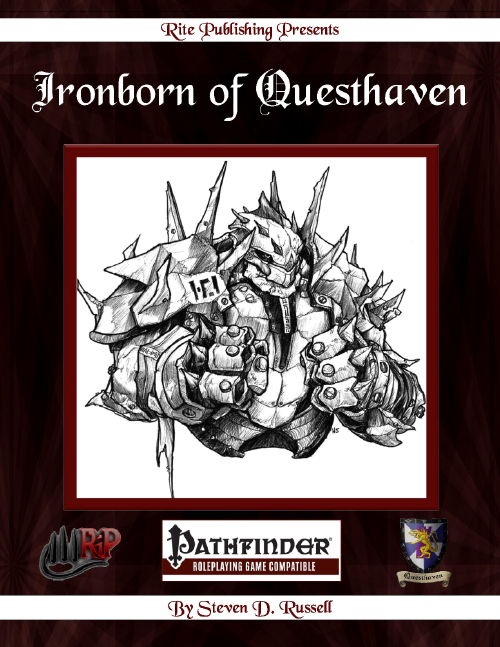 Ironborn of Questhaven
Disclaimer:
I HATED, HATED, HATED the Warforged. There are several reasons for this and it has, quite frankly, been the main reason for me not to buy this pdf for a long time. Until one of my players asked, whether it would be possible to play a gear-enhanced human and presented an excellent 4 page background story. I dislike construct races for PCs, but his concept was cool.
To the review:
The pdf is 21 pages, 1 page Front cover, 1 page credits, 2 pages ads, 1 page OGL. That leaves 16 pages.
This is a portent of the things to come: Ironborn are extremely modular and the better for it.
After reading this paragraph, I could see:
The base race is VERY well-balanced and the Ironborn-subtype features the construct-flair without making wilderness/starvation/environmental adventures a joke for the character. Kudos!
The true strength is the versatility of the race, though. You choose a base-suit of abilities according to the purpose of the Ironborn. We get 6 pages of ability packages, with primary and secondary (not accessible for large Ironborn) abilities and sometimes, even a variety of secondary abilities for a given suit.
The ability suits are well-balanced, with one possible exception, depending on the power-level of your campaign: The Centurion Suite is, on low levels, the ULTIMATE tank. Plus, it hits a pet peeve of mine: It has a 25% chance to negate crits against the players. This is the only suite I'd exclude for my players, at least until they are level 5. My favorite was the Omenbuilt, Ironborn reborn under a certain omen, thus granting them tokens when they fail at certain checks: I'm going to use the mini-token mechanic for other chars, too. Awesome!
We get 2 pages of physical and psychological peculiarities of the Ironborn.
The concept of the "burden", i.e. an instilled craving to do what it was created to do helps to easily drop them in any adventurer group and makes for nice roleplaying opportunities.
Then, we get a new sorcerous "bloodline" and a feat to construct Ironborn.
After that, we get 9 new feats, mostly for Ironborn and new rules for clockwork familiars. This takes up 3 pages.
The feats are well-designed and don't seem to be too overpowered, although two of them hit another pet peeve of mine: "Spring-loaded Reflexes" and "Intricate Joints" give Ironborn access to uncanny dodge, and improved uncanny dodge, respectively. These are class features for me, not something that other classes have readily access to without multi-classing.
While the prose is good, it's not as compelling as the prose in the "Wyrd"-pdf.
Conclusion:
Due to the fact that it hit 2 pet-peeves of mine, I give it 4 Rudii. Highly recommended for any campaign and better designed than the warforged, Ironborn are as versatile and easy to integrate as can be, avoid many of the unbalancing contruct-traits and still manage to keep the "special" fluff of the construct race for $3.7.
 This pdf consists of 16 pages, 1 page front cover, 1 page OGL and 1 page advertisement, leaving 13 pages of gaming material.
First of all, let me explain what or rather who the Wyrd are: To sum it up, they are a crossbreed of elves and ogre-magi that has transcended both of their parental races. (At least in the eyes of the Wyrd!)
The Wyrd are tinged with a foreign, slightly oriental tinge in tone that is expertly conveyed to the inclined reader in the beginning of the pdf. Unlike some companies, Rite Publishing combines the rather dry basic crunch-characteristics of any given race with prose written in-character, which, at least for me, has made reading this pdf much more enjoyable than reading run-of-the-mill race books. The section on the basic Wyrd traits as well as the introductory fluff spans 3 pages.
With regards to the race, the Wyrd are very interesting and predisposed towards casting classes, getting +2 to both Intelligence and Charisma and -2 to Dexterity. They also get a very minor SR, which I was weary of at first. I playtested it, fearing SR with ANY PC race and it actually is not overpowered. Nicely done. At 8th level, not unlike some races in variant settings, the Wyrd gets a late spell-like ability from a restrictive, but neat little list. Again, this did not prove bothersome for me.
However, the Wyrd also get +2 on checks to overcome SR and dispel checks and, depending on the campaign you run, this feature may make them a bit stronger than the PF Core races. In my campaign, where almost all supernatural beasties have SR and PR, the Wyrd but be slightly stronger. If you run a rather normal campaign, you probably won't have that problem.
That being said, let's move on to the racial Paragon Class for the Wyrd. For those unfamiliar with the concept: It's a Prestige Class that hones your racial abilities, making e.g. dwarves even harder, elves even more dexterous and elvish and in this case, making the Wyrd...well. More agile, enabling him to do extreme acrobatics, letting him grow to large and making him more...what is the attribute? Wyrdish? While the abilities are cool, they are balanced with only one good save (Will), a measly d6 hitpoints and only 2+Int Skillpoints per level, thus on the one hand giving the Wyrd great abilities and on the other hand preventing him from becoming too powerful. The Paragon Class takes up 1.5 pages.
After that, we get 11 new feats to customize the Wyrd, taking up 2 pages. Some of them serve to either customize your Wyrd at character creation (e.g. with an aquatic elf or drow bloodline) or grant the Wyrd permanent enhancements. The latter may look at first a bit daunting for a DM, however, all of them have the added clause that a certain ingredients have to be acquired first, which I personally think, is a very good idea. There is also a neat metamagic feat called "Programmed Spell" which I'll be using extensively.
The section takes up about 2 pages.
After that, Sorcerors get the new Oni bloodline. While it is concisely designed, it didn't really make me gasp in excitement. 1 page.
After that, though, we get the crown jewel of this pdf, at least in my opinion: The Prestige Class "Whispering Advisor of the Emperor Dragons". Once again, the fluff for this PrC is expertly written and very captivating. In essence, it's a skill/social-monkey class with very innovative abilities at every one of its 5 levels.
Power behind the Throne: Lets you help allies in battle or situations.
Whispered Advice: Use PbtT via whispering wind if you succeed a stealth check
Chosen Loyalty: Insight bonus to saves against charm and compulsion
Trap of Vengeance: Awesome plotdevice, this trap-ability makes use of the vengeful nature of Wyrd (which btw. is not vicious, but portrayed as reglemented and [mostly] honorable) and is just extremely cool.
Whispers of Despair: Demoralize opponents
I'm usually not into bard-like classes, but this one really made me want to play a whispering advisor. Awesome work! 2 pages.
Conclusion:
There is a minor downside to the uniqueness of the Wyrd though: Basically, your campaign world should have both elves or fey and ogre-magi for the race to work best and it would be even better if you had an eastern/oriental-tinged area somewhere on your world. After some thinking (and a suggestion by Steven!), I figured out a way to implement them into my Ravenloft world, so it is possible. However, the race is not wholly plug-and-play: Fluff-wise, you have to think a bit to implement them without losing a part of their uniqueness, but they are worth the effort.
Oh yeah, one last thing: Thankfully, the Wyrd are not a bunch of angsty half-breeds that don't fit with their respective parent race cultures, but have their very own, which they also consider superior to their parent's cultures.
Very refreshing after an army of angsty half-elven Tanis-look-alikes and Half-orc/ogre/troll/dragon/whatever misfits that have plagued fantasy gaming for the last couple of years.
The artwork is nice, I did not notice editing mistakes and while some of the feats were not as awesome as in other Rite racial books, some others were.
In combination with the racial paragon class and the awesome PrC as well as the fact that this race really DOES feel unique, evocative and new. For the rather cheap price of $3.75 and the high production values, I'll settle for a solid 4.5 Rudii with a tendency towards 5.


This pdf consists of 17 pages, 1 page front cover, 1 page ad, 1 page OGL, 1 page editorial.
The art by Hugo Solis and Joe Calkins is of high quality.
That said, you get a nice 4 page IC introduction to the "race" (actually more a template) and as a bonus for DMs like me, who like to print out pictures of characters, 2 one-page portraits of the characters on the cover to present to your players. Nice touch!
The design of the "Restless Soul" template is elegant, using a subtype of outsider to get around the unbalancing undead immunities and, while giving the restless dead a kind of penalty for PCs that just died, also ensuring that this penalty can be offset. The prose is topnotch, but I'll comment on that later on.
After that, we get 22 new feats, most of them for Restless Souls and one of them to ensure that your PC comes back as a restless dead (Soul Jar).
Examples:
Aura Sight: Lets you determine nature and strength of other creatures
Baleful Gaze: Due to a painful death, you can let your enemies collapse in agony with a glance a limited number of times per day.
Companion of Light: Gives you a soul-light companion. (Spirit Lantern)
Converse with the Dead: Talk to the dead.
Fading Form: Lets you blink.
Love and Friendship: Due to the bond with a ward, you and the ward are continuously under "shield other".
Master the Storm: Control the Weather for the right mood.
No Last Rites: Makes you a regenerating badass.
Unfinished Task: Gold for Oathbound and similar honor-bound characters, lets you ignore debilitating effects in regard to the task once per day.
And so on.
The feats are plain AWESOME. Many of them are so imaginative and cool that my players would create characters based around feats like this as a concept! While some of them seem to be powerful at first, they are neatly balanced by availability due to death, monetary costs and the like.
After that, we get 10 new spells, ranging from level 0 cantrip "Apparent Distraction" (lets you try to hide when enemies are looking) over lvl 4 "Enforced Choke" (choking an enemy to death, great assassin-spell), lvl 7 "Implacable Beast" (summons a creature stronger than you to kill a target; If successful, you are destroyed) to lvl 9 "Virtually Indestructible", granting an item exactly what the spell name says.
All of these spells have in common, that they are to some extent clever, cool and all of them both are balanced and serve a specific need.
Conclusion:
The prose is awesome and, at least for people like me, who are inclined towards the darker subcultures and music-styles of metal and goth, just plain awesome in its cynical tone, making fun of the angsty cliché of "I wanna play kewl 1337 pseudo-undead tormented creatures" while actually utilizing the cool characteristics and tropes associated with just that and making them playable. Furthermore, "Restless Souls" can easily be implemented in just about ANY campaign.
Don't like the implied semi-gothic, cynical tone? All right, why not use the rules for Planescape-like Petitioners?
You know that a book is good, when the template spawns ideas for characters, feats spawn ideas for characters, prose spawns ideas for characters and spells spawn ideas for whole adventures (Implacable Beast, I'm looking at you!) - Plus, the fact that the feat for assured return as a restless souls gives players who have grown attached to their characters an additional option in campaigns that are loathe to use the Raise dead/Resurrection-mechanic of the core-rules.
Plus, I can see e.g. "Love and Friendship" leading to great, tragic, touching scenes in play.

The pdf kicks off in the manner and quality I've come to expect of Rite Publishing: We get an in-character introduction to the race that is very flavorful and appeals to the scholar of Scandinavian culture that is yours truly. We get two defining social concepts for the race of Jotunnar,that are described herein. They are Humanoids who can embrace a birthright and evolve into different kinds of giants via two social roleplaying concepts (and of course, XP). The concepts are called Vird and Osoem. Personally, I love flavorful, beautifully written texts that make me want to play a given race. The general introduction and fluff is 4.5 pages long and a perfect introduction that makes the Jotunnar feel unique and has a nice tie-in with the fluff of the Wyrd.
After that, we get the racial traits as well as the Jotun racial paragon class. The class has, 4+Int skills, a good fort-save, medium BAB-Progression and gains an improving unarmed attack and improving natural armor.
One drawback to this class that limits its usability is that you can't class in or out of the Jotun paragon class. Once you have taken a level in the class, the awakening elemental powers would tear the Jotun asunder if he/she chose to take a level in another class. While probably necessary to balance the class, I still think it's a pity.
Your Elemental Power also opens a HUGE selection of 40 abilities, making the class quite versatile. From abilities like Backbreaker to Elemental Auras, Jotunnar have a nice selection ready to surprise their enemies.
Jotun also get a slam attack, natural armor, rock throwing and catching and increases in size, Strength and Constitution. It should be noted that Jotunnar may change their sizes back to smaller sizes via actions so they can continue to adventure with their non-Jotun friends.
After that, we get 18 feats for Jotunnar, most of them dealing either with evolving into a specific kind of Giant or fighting with rocks. While they were nice, I did not find them quite as evocative as e.g. the feats for the Wyrd.
Conclusion:
This pdf is beautiful. The artwork is awesome, the editing and formatting is good (I didn’t catch any mistakes), the prose is extremely atmospheric and the ambition of the project is daunting: Make a giant playable without losing the flavor or OPing it. The pdf accomplishes what it set out to do, although the no-multiclassing-ever-restriction is quite hard to swallow. If you want to play a giant, this is for you. However, if you want to play a Giant Druid or something like that, you can’t do that, which is kind of sad. While the class offers a huge set of abilities, I still would have liked some kind of Jotunnar-racial-PrC that they CAN take without dying (In a future release, perhaps?) or some Giant-specific magic items, though.
Due to the multiclassing restriction as well as the lack of a PrC or e.g. magical Jotun-bags and the like, I'll rate this 4 Rudii. If you don't mind the multiclass restriction, add a Rudi.
If you’re a DM looking for a refreshing take on Giants or a player wanting to play one, check this out. At the very least you get an awesome read for not even 4 bucks. Plus: Steven D. Russell has announced that we'll probably get new Jotunnar-PrCs and options in the Questhaven patronage project.

This pdf is 16 pages long, one page front cover, one page editorial, one page advertisements and one page OGL. That leaves 12 pages of content.
The pdf kicks off with the by now obligatory, glorious and well-written in character introduction to the race I’ve come to expect from Rite Publishing. In this case, I was almost immediately taken in by both the elegant solution of the problem of the Bestiary gargoyles as well as a flash of nostalgia: The concept reminded me of the gargoyles animated tv-series I grew up with and I love it. A permeating sense of melancholy is present within the writing and serves well to convey the mindset of the Stonewardens (the PC gargoyles), that have been betrayed by mankind and still, oath-bound, silently guard the thin-skinned races.
After 2 beautiful one-page artworks and the introductory texts on age, height, mindset and so on, we get the Stonewarden Paragon racial class.
The class gets 4+Int skills, a good BAB, a good Fort and Will save, claws, bite and gore attacks. Better yet, they get so-called enticements, mutations you can choose for your Gargoyle. You can e.g. get a tail, spit acid, grow extra arms and become a damn hard hitter in melee – a gargoyle with several arms, a tail and bite attack is a potentially fearsome for to behold indeed! What really sold the class on me, though, is that even mundane things like a bonus on survival and perception gets fluff: The Stonewarden touches a stone and communicates with them. Oh yeah, and the lvl 20 ability is GOLD for high-level investigations or food for a truly mastermind-type villain. Each and every ability has been written with flavor in mind and practically screams “gargoylish” to me.
After that, we get 7 new feats, most of them developing the ability and combat tactics being able to fly entails.
Finally, we get 10 new spells ranging from 1st to 9th level that just ooze earth elemental coolness and which I’d really like to throw at my PCs: From rolling shockwaves over partial petrification up to a devastating hail of boulders, the spells serve as a nice closing for the pdf.
On another note: In contrast to Jotunnar, Stonewardens may freely class in and out of their racial paragon class, which really helps to integrate them and make them more versatile in their usability.
The editing is top-notch, the b/w artwork is great and the amount of information cramped into the pdf is stunning, especially with the high-quality prose.
Conclusion: Would I want to play a gargoyle? Hell yeah! Would I work as a DM to implement them in my campaign world? Oh yes, I would, even if it were harder than it is thanks to the great prose. Would I recommend this file to you? Yes, definitely. Even if you are only remotely intrigued by the concept, go for it. My final verdict is 5 Rudii.
This concludes, at least for now, this little reviewing-spree.
All th best, thank you for reading my reviews,
Endzeitgeist out.
9.29.2010
Secrets of the Alchemist by Open Design
This product is 12 pages long. It starts off with a cover and ToC. (2 pages)

Endzeitgeist's Start a Campaign for free III
It's been a nice ride, we have a backdrop location, an adventure to kick off the campaign and now, what do we need? Bingo, additional Stuff! Feats, monsters, options and items and that is, what I'll provide!
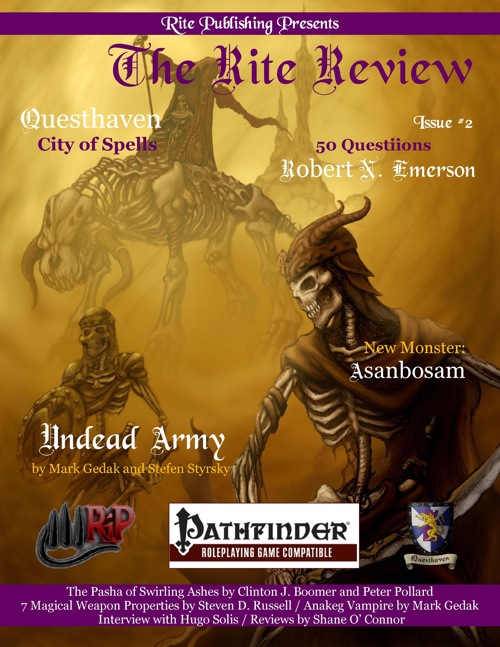
First of all, there is a nice magazine called "The Rite Review" put out by Rite Publishing that has some interesting content you might want to scavenge. D_M has written an extensive review of the first issue, which you can check out (and download) here.
My review of the second issue:
This pdf consists of 65 pages.
1 page Front cover, 1 page back cover, 1 page OGL, 1 page table of contents and 16 pages of ads, leaving 45 pages of content.
There is one page of editorial, which was a nice read about being a 3pp and the chance to influence "mainstream" PFRPG.
Then you get 2 pages of new magic items, including nice fluff and bardic lore/Knowledge (Arcane) checks. The first is an instrument that can be used very swiftly, the second a gem to help with bardic lore and the third is an amulet helping you with your domain. The highlight here, is the prose, though. Captivating and concise.
After that we get a 7-page interview of 50 questions with Robert N. Emerson, mostly on the "Litorians"-book by Rite.
Following up, we get a gorgeous full-page illustration of the "Pasha of swirling Ashes" by Jason Rainville (taken from the Coliseum Morpheuon patronage project by Clinton Boomer) as well as his 1-page statblock. Got curious? Check it out! I haven't regretted being a patron for CM for one second!
Following up, you get the statblock of Venn "The Vulture" as well as a sneak-peak at the poison upgrades and feats from Rite's "Evocative City Sites: Rogue's Gallery Tavern", a highly recommended location that costs a measly $1.99.
I've written a review, so, if you're interested, go check it out.
After that, it's crunch-time: 7 new magical weapon properties is a preview for the Rite-book containing 101 of them. They are clever and neat.
Then comes the crown-jewel of the issue, at least for me: The 3 pages strong "Army of Darkness"-article helps the fledgling, world-conquering necromancer with new feats, a new rule for spontaneous undead creation, a new undead archer and 2 deadly and cool new arrows that put the fear of undead back into the hearts of those sun-worshiping radicals.
Awesome.
"Ghouls stalk the Night" is a cool 3 pages sidetrek with nice fluff that, thanks to 3 different statblocks can be used for different levels. And I can't see any group guessing what the creature is. Creative idea, for sure.
After that, we get a short, 1-page introduction to Questhaven that doubles as a preview for what to expect of the City of Spells series. Cool! we get more on Questhaven with the 1-page article "Rise of a Merchant Prince", plus the useful "Stone of silent alarm".
"Changing Fashions" deals with fashions in a high-fantasy town and the issues and is a nice supplement to the "Evocative City Sites - Intimate Shape Festhall".
The Aku-Boma is a new, intelligent plant monster of the creepiest sort. Spellcasters trying to bypass it will have a lot of fun... Hehehe.
Then there is "Jolunga", a suped-up, earth-infused, advanced bulette. Cute Critter, 2 pages.
The final new monster (again 2 pages) is the "Asanbosam", a predator-like aberration that can put the fear of the woods back into your PCs.
After that, we get 1 page of advice on using "Evocative City Sites", to be precise, "Kavit M. Tor's Emporium of Collectible Curiosities", followed by a page of 5 new first level spells from the upcoming "101 1st level spells" book, due on June 1st.
Then one can read a 2-page interview with Hugo Solis.
After that, we get the review section:
"Liber Vampyr: Secrets of the Blood" (2 pages), "Ashton Sperry's Paper Minis: Litorians" (1 page),
"Incantations from the Other Side: Spirit Magic" (2 pages),
"Darkness without Form: Secrets of the Mimic" (1 page),
"Adventuring Classes: A Fistful of Denarii" (2 pages) all written by Shane O' Conner,
"Heroes of the Jade Oath" (2 pages) by Dark Mistress,
"Kavit M. Tor's Emporium of Collectible Curiosities" (1 page) by Mairkurion {tm}
and Rituals of Choice 1: A Witch's Choice (1 page) by Megan Robertson.
5 Rudii, come on! You get all that for FREE.

All right, ol’ Endzeitgeist has even more stuff for you:
Do you need some additional feats or just some buff for your bards? Here you can download one fine file by Spes Magna Games for free, to be precise: "Latina Facta & Versatile Performance Redux".
This pdf is 10 pages long, 1 page front cover, 1 page editorial and 2 pages OGL. That leaves us with 6 pages of content.
Latina Facta (2.5 pages): 15 feats that are based on famous Latin sentences. Most of them are quite cool and seem to be well-balanced.
One particular, though, at least to me, screams unbalanced: "Aequam Memento Rebus in Arduis Servare Mentem" – the feat lets you add your wis-modifier to any skill-check with a DC of 25 and higher. While unproblematic on lower levels, it means that mid-to high level characters will add a huge bonus on ALL skill-checks. No way, this will never be used in my campaign.
There are also cool feats like "Age. Fac Ut Gaudeam!" (Go ahead, make my day!) that force a via Intimidate demoralized foe to delay for 10 points on his next initiative.
My personal favorite, though, is "Cogi Qui Potest Nescit Mori", which enables you to resist acts while under an enchantment for a slight subdual damage.
The second part of the file consists of new Arts and Associated Arts for the Bard-class and are simply cool.
Ever wanted your Bard to dance over a spider's web? Or wanted your bard to call "Cut!" on an enemy and truly stupefy him? There you go. 3 and a half page of the pdf are devoted to making your bard more awesome, versatile and cool. For a class that rarely sees such cool concepts, this file is pure gold.
The editing, wording and formatting are high-quality, however, don’t expect too much artwork-wise. While there is some b/w-art, it's minimalistic and probably public domain.
Conclusion:
"But wait a second," you're saying, "Endzeitgeist, this one DOES cost $0.99!" Well, yes and no. Spes Magna Games has been so kind as to provide the file for free on their own page. You can get it here.
While the feats were nice, I would have loved to see more versatile performances – they are plain awesome. Due to the one feat I didn't like, I'd give it 4.5 Rudii, but for FREE, I’ll round it up to 5. Bard-lovers, go get this one – you won't regret it.
Ok, so you’ve got some extra feat, stuff for bards, monsters etc. – what is missing?
Yep, you’re of course right: Magic items, preferably some low-level ones. (It’s “Start a Campaign for free”, after all!)
Yeah, I’ve found a nice little book by Necromancers of the Northwest for you:
Into the Armory
This pdf is 59 pages long, 1 page front cover, 1 page editorial, 2 pages Necromancers of the Northwest-logo and ad, 1 page back cover, 1 page OGL and 1 page table of contents.
That leaves 52 pages of content for this file. Let's dive in:
The pdf kicks off with an introduction on two concepts, i.e. Quasi-magical items (magical items that cost less than 2500 gp and may very well have no aura) and siege weaponry. Quasi-magical weapons have one supremely cool feature, which I've been using for years in my game: To construct them, you need ingredients, which are also listed. I'd love to see that more often.
Chapter 1 details armors (11 pages):
We get two new mundane armors, one medium and one heavy. We also get 3 new quasi-magical armors: One woven from clouds (think good-looking PCs and strong winds), exploding armors (essentially suicide bomber armors that deal a whopping 20d6 damage – might not be appropriate for every group and should be used with care by both PCs and NPCs…) and swarmnest armor, which transports a swarm but unfortunately lacks hard rules for the swarm – I guess that it does behave like the creatures from the bestiary and not the spell, but I'm not 100% sure.
Then, we're off to steam-punk-county with three so-called Golem-armors, which essentially are mechas your PCs can pilot. 2 One-man armors and one that can be piloted by up to 5 PCs. I like the concept and they don't seem to be that powerful. Might be a nice addition for some campaigns.
We get 11 new armor properties, which are interesting, but one of them, "Modular" should be flat-out disallowed. It makes it possible for PCs to change the particular enchantments for a armor every day. Flat-out OP.
After that, we get 7 specific magic armors. Notable examples would be "Iron Body", which makes you strong but stupid for 24 hours, a rust-monster hide and a powerful armor for paladins that punishes not adhering to a VERY strict moral code. The "Rust Monster Hide" seems a little OP for low-magic/rare-magic campaigns to me, but works well in other settings.
Chapter 2 has new shields for you (4 pages):
We get two cool new quasi-magical items and 3 new shield special abilities, one of which (Insignia shield), unfortunately fails to mention how long the summoned creature stays. The next 6 new specific shields are quite useful, balanced and cool, especially the Planar Gateway Shield: One second, it's a shield, the net second it's your gate to another plane.
Chapter 3: Weapons (11 pages):
We get 10 new mundane weapons, all of which I liked.
7 new, quasi-magical items are included in the mix, ranging from a grappling shot over net grenades up to a whip blade. We also get 19 new specific magical weapons. I liked the ideas within, especially the "Lightning Trident", (which should be modified to always include the wielder, though), but "Nocturne’s Fang" does not specify which potion corresponds to what kind of blood and the “Scythe of the Wretched” is op beyond belief: Once per day on a crit you are practically guaranteed to kill your enemy. If you're lucky, this could kill just about anything.
Chapter 4 deals with new equipment (10 pages):
We get the concept of randomized potions and 4 new rings, my favorite being the “Ring of useful things” – complete with a 10ft-pole) and my least favorite being the mood ring. A suggested DC of 15 to change what a character feels? Yeah, right. We also get a new rod and the concept of the randomized wand. 16 wondrous items are up next. Some of them are really cool, e.g. the “Lens of the Sun” or the “Gem of Vision”. The rest is rather standard-fare.
Chapter 5 deals with miscellaneous items (9 pages):
The 6 new alchemical items presented are extremely cool and useful. You'll like these. We are then introduced to 3 new so called “Living Items” – alchemically treated living organisms that range from a flower that makes you breathe water for 3 minutes and swarms-in-a-bottle, i.e. magebane and necrotic wasps. Good ideas there. 5 new poisons are also within these pages, from rather mundane choking/sleeping powders to the far-out polymorph poison.
We also get 7 new special materials to craft items from, favorite among which is the so-called Talectini, a symbiotic, living armor. My least favorite of the materials is Soul Steel, which is a little bit OP in my opinion.
The last chapter deals with siege weapons (6 pages):
We get short and concise rules for using siege weapons, including stats for 4 siege weapons. The chapter also has 4 special weapon abilities, 5 magical ammunitions and closes with 4 specific siege weapons.
The fonts used in this pdf are clear and concise. There are some minor editing glitches and the pdf features a brownish background, which is not perfectly printer-friendly. The fluff-texts for the chapters and comments of the vendor of those items are quite nice and, while not brilliant, they are entertaining. Art-wise, you get a picture at the beginning of each chapter, but don’t expect too much.
Conclusion:
The pdf suffers from some problems of "First Pdfs", i.e. some glitches have slipped past and some rules could be clearer. Some of the items seemed a bit OP for my rather conservative tastes when it comes to PC-strength. However, both the siege weapons and especially the quasi-magical items are very cool: I think that suggested ingredients should be provided in the craft-stat-block of any magical item – it only enhances enjoyment and makes fighting enemies even cooler, as your PCs try to scavenge monster-parts and then enhance their boastful stories of their exploits when drinking in the tavern.
While this pdf may be far from perfect, it is a valiant effort and contains some rather far-out and/or excellent/useful ideas.
Plus: This pdf is FREE, you can get it e.g. here.
Normally, I'd rate this lower, depending on the price somewhere around 2.5 - 3.5 Rudii, but for free, I'll give it 4 Rudii – there are some issues that would irk me, had I paid for it. But for free, it's a nice addition to your collection.
That's it for now, I hope you'll enjoy the books and the experiment "Start a Campaign for free". If I stumble over more interesting free stuff, I'll be sure to let you know!
Next time, I'm going to review a couple of race books by Rite Publishing.
I hope my ramblings proved to be useful to you all, until next time,
Endzeitgeist out.
Subscribe to:
Posts (Atom)
