6.21.2012

EZG reviews Brace of Pistols & 101 Not so Random Urban Encounters

Hej everybody,

today I'm going to take a look at the esteemed Lou Agresta's new sourcebook all about flintlocks,

SGG presents: Brace of Pistols
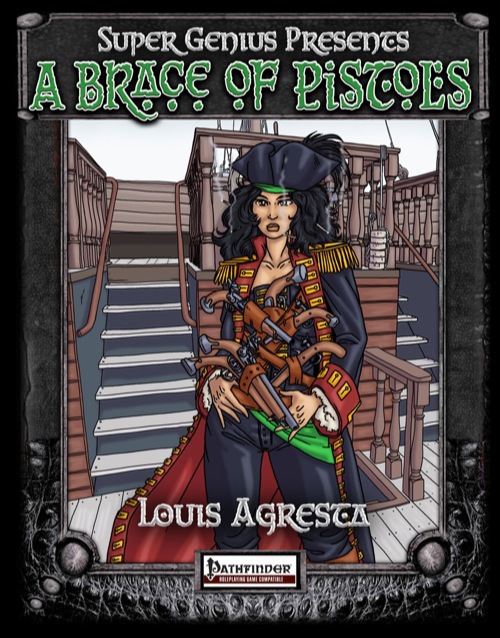


This pdf is 15 pages long, 1 page front cover, 1 page editorial/SRD, leaving 13 pages of content, so let's check it out!

After an aptly-written piece of in-character prose, we are introduced to a bried historic introduction of flintlock muskets and pistols, including an artwork as well as a step-by-step description on how they actually work - don't fret, though: While interesting to read, the pdf loses no time to introduce us to a series of new early firearms: From 4-to 8-barreled Duckfoot-pistols (spreading out shots) to derringers, Jezails (long-barreled muskets with a curved stock that can be tucked under the shoulder) and short-barreled muskets (called musketoons), we get a neat selection of them - coolest among them, at least in my humble opinion, being the boarding gun - massive, made to be used as a stationary weapon, it takes a lot of time to reload and when not braced against a solid wall or something like that, damages the wielder with its massive recoil - the damage and spread, though, make this usually stationary weapon an interesting choice for adventurers nevertheless.

After introducing these new types of flintlocks, we are introduced to a selection of new firearm options: If you wanted to have a cane, a codpiece or a similar inconspicuous pistol concealed in a regular piece of clothing or jewelry, rejoice, for now rules are provided to do so. Creating gun traps for doors, chests etc. as well as adding spring-loaded bayonets and even axes/maces and all other kinds of melee weapons to flintlocks is also covered in this section, as is the option to add a second trigger (for sniping). My favorite, though, would be the mortar cup, which enables one to shoot bombs and similar alchemical items - very cool!

Of course, flintlocks are not only weapons and modifications - they also cover supplemental equipment: 3 new types of holster and belts that hold lead balls and prepared shots are covered, as well as silk patches and slow matches (which burn longer and can be woven into one's beard for a bonus to intimidate) as well as cleaning kits. Cleaning kits? Yes, for two optional rules I personally enjoy are part of the deal: Catching fire with flintlocks as well as the influence of bad weather, dirt etc. - the upkeep of a flintlock, cleaning it etc. after all was a significant factor in their effectiveness and thus, these rules make for a cool, albeit wholly optional addition to one's game. Speaking of additional rules: Another optional one is the one to allow rogues and similar characters to perform ranged disable device checks to shoot open locks.

And then there are 4 new feats: "Pistols at Dawn" makes you a master of formal dueling, "Get the Drop" enables you to get a bonus to initiative and make a single attack against an opponent instead of your regular  actions and then there is "Powder Burns" and its "Improved" variant and damn are these two cool: If you shoot an opponent, you may make  a secondary attack against an adjacent opponent, dealing fire damage and temporary blinding said foe. Cool tactical options that come with interesting rules and feel balanced. There are also two new spells, "Imbue shot" (lvl 5) and "Greater Imbue Shot" (lvl 7) that enable you to imbue spells into bullets and in the greater version, even have your shots deal no damage, instead delivering beneficial effects to the person hit. The tactical options these spells provide are rather interesting indeed. The pdf also contains two new magic weapon properties: Auto-loading, you guessed it,  eliminates the reloading action, enabling you to make full attacks, while the Everdry-enchantment keeps powder-weapons, again, you guessed it, dry.

That's a lot of cool crunch, but there's also stellar fluff to go with it: The pirate game of Mahga-mahga, a brutal game of intimidation, torture and potentially death that involves a captive, a chandelier, a lot of grog, a cabin boy/girl, a charcoal stick, a lazy susan, rope, dice and an optional cleric. I'll give you a hint: The captive gets some marks that indicate areas that are hard to hit and assign point values to them. The chandelier will be spinning. Powder burns and greedy grabbing for gold are also expected, as is the wanton consumption of grog. Better yet, the game utilizes the new powder burn feats to maximum capabilities and comes with rock-solid rules to handle this sadistic pastime in-game. Want to know how it works? Buy this pdf. ;)

Conclusion:
Editing and formatting are very good, though not perfect: I noticed two minor typos. Layout adheres to a 2-column standard and provides nice full-color illustrations of most of the new weapons and pieces of equipment to further illustrate them. The pdf is fully bookmarked, which is a big plus in my book.  First of all: Yes, I'm a sucker for firearms and deeply entrenched in the pro-gunslinger camp. However, if you take a look at e.g. my review of NNW's take on the Gunslinger, you'll realize that I'm anything but forgiving when it comes to faulty rules.

"A Brace of Pistols" is an interesting pdf - in just a couple of pages it gives a concise presentations on how the weapons worked, adds a slew of new ones to the mix (including rather innovative rules) and delivers stellar customization options for your gunslingers and scurvy pirates. It is said customization options that are, on my opinion, the star of this pdf - don't get me wrong, I enjoy the optional rules as well, leaning more to a simulationalist style of gaming myself, but they can be easily ignored if you don't like them. The spells are neat and especially the powder burn feats are awesome as well, but along the cool game, it is the option to finally have a codpiece (or even eye-patch)-pistol that made me grin like a shark. Louis Agresta has created an awesome little pdf that could just as well be used to depict steamwork-crossbows and steampunkish weaponry and succeeds in delivering a variety of new tactics that are guaranteed to enhance your enjoyment of flintlocks in your game. For fans of the gunslinger this is a must-buy and for everyone remotely into swashbuckling and some of its not yet covered aspects, this pdf is gold as well. If what I told you about even remotely intrigues you, take a look. My final verdict for this humble, yet incredibly useful little pdf will be 5 Rudii.


But that's not all I've got for you today! By now I'm a rather jaded individual and am hard to impress by most publications. However, Rite's latest installment of the 101-series has managed to do it!


101 Not so Random Urban Encounters


This installment of Rite Publishing's 101-series is different and that becomes readily apparent by taking a look at the page-count - 51 pages, 1 devoted to front cover, 1 page editorial, 1 page SRD and 1 page advertisement, leaving a  whopping total of 47 (!!!) pages of content devoted to new encounters, so let's check them out!

If you're a patron of Questhaven (Rite Publishing's upcoming city-setting), you'll be familiar with the basic premise of this pdf, if not, I'd suggest especially players to jump to the conclusion. Just let it be said, that the basic premise is awesome and that this pdf takes a completely different approach to encounters than e.g. one can see in Raging Swan's excellent "Caves & Caverns". Instead, the creatures indeed are distinctly "Not so" random.  This pdf is dedicated to me (thank you, Steve!) for reviews good and bad - so in which category does this one fall?
 
SPOILERS follow.

You have been warned. Still here? All right! In the magical renaissance of Questhaven, there is an organization called "The Fold", essentially an organization of organized monsters - think "The Godfather" with monsters. Worse, all the individual monsters can thus combine their powers, making the Fold a formidable force indeed. Spawned from the rich background currently being developed in the Questhaven-project, this installment of the "101-series" provides us a plethora of NPCs that are tied together by this frame-organization. It should be noted, however, that the individual entries can be taken and used by their own - in no way are you restricted by the narratives to use the beings herein as part of the Fold.

It should also be known that most of the creatures herein have more than one use, one CR respectively and can not only be considered foes to kill, but actually intriguing characters to interact with. Need an example? What about the Rakshasa maharaja who awaits the natural death of his powerful wife to reincarnate her as one of his own people. Oh, and she's an advanced exemplar harridan lamia. (With full stat block!) Said rakshasa also gets his own, modified war juggernaut. Even better, while not every NPC herein gets a full statblock, where applicable, quick modifications provided in the entries can be applied to the basic statblocks.

Not only  are there multiple instances for interesting (and often rarely used) beasts that have been made true characters, including a whole network of relationships entwining the different component parts of this cell of the Fold, the characters also can be considered beyond all doubt iconic: Take Jack Straw, for example: A pale stranger that has lost all ties with mankind and usually appears disguised as a scarecrow! Undead, gunslinging scarecrows? Yes, please! Or take lonely Skanda of the thousand whispers: A collective of thousands of mandragora plants, the creature comes with both a single,  swarm and collective form and takes up three of the entries - and its roots are, truly, everywhere - keeping a secret from this spymaster should provide to be a rather significant challenge. Hunting-falcon style domesticated stirges?  Medusa apothecaries? Or what about an enforcer who is actually a dream-spectre and known as the "Romantic Nightmare" due to its disturbing courtship habits?

In the end, the pdf provides tables by party levels for the creatures to roll, if you're so inclined.
Conclusion:
Editing and formatting are very good - while I noticed some minor glitches, they were few and far in-between and did not impede my enjoyment of the pdf. Layout adheres to RiP's two-column standard and the artworks are ok. The pdf comes with bookmarks for every 10 NPCs - Cr-information for the respective beings would have helped. I'll come right out and say it: This pdf is not perfect in its formal criteria - there could be more bookmarks and there are minor glitches. Usually, that would deter from my enjoyment of the pdf enough to warrant a downgrade in the final rating. However: This pdf is awesome. Steven D. Russell is an expert writer and I'm a  huge fan of his fluff. Enjoyable to the extreme, this pdf is one of the rare pdfs that immediately make you come up not with a hook, not with an adventure-idea, but with a whole array of possibilities, enough to spark a  whole campaign in fact. It is rare these days that a pdf can truly surprise me with its imaginative potential. Rarer even is the pdf that has me smile at the coolness of the idea and indeed, this pdf had me smile -  a lot.

Colorful enough to be the cast of a novel (or a whole series of them)  the beings herein a so different from what one usually expects that I can wholeheartedly say that NONE of the beings herein can be considered filler. Add to that the intricate web of connections and social relationships and you not only get a vast variety of interesting creatures, but also a portray of a complex crime family that has a staggering array of options and strategies at their disposal, challenging your PCs when trying to outwit the Fold. The writing and imaginative potential contained in these pages is superior and frankly, the characters in most novels are less colorful.

This is one of the installments of the "101 series" that BELONGS into any well-stocked GM-library - and if you're e.g. planning an urban campaign, this is essentially a must. Even better, if your own campaign has become stale, take this pdf and make the creatures herein perform a  hostile takeover of a local underworld or even a kingdom and watch your players struggle. The potential is vast and thus, in spite of my minor gripes, I'll settle for a full verdict of 5 Rudii + endzeitgeist seal of approval.


All right, that's it for now - as always, thank you for reading my ramblings,


Endzeitgeist out.

6.19.2012

EZG reviews Gods Of Porphyra (aka Open Faiths Project)

Hej everybody,

today I'm taking a look at a great project: 3pps have long time suffered from generic deities and today, this is remedied by the open content of PDG's

Gods of Porphyra


This pdf is 45 pages long, 1 page front cover, 1 page editorial, 2 pages of SRD and 1 page advertisement, leaving 40 pages of content - quite a bunch for this new pantheon, so let's check out these gods!

Porphyra, until recently, as the aptly written introduction  tells us,  was a world without gods - and then elves and orcs united and saw their world almost torn asunder by the arrival of gods and the integration of the respective divinity's  domains. That's about the general gist on the fluff-side. Beyond that, this pdf is also the open faith project, making all these deities actually open content and thus potentially available to other 3pps - but should one rejoice and hope people take up on the offer this pdf provides? It should be noted, that each of the gods herein has 4 domains and 4 subdomains - Speaking of them: The pdf provides the new art and time domains, with the movement, sound, future and past subdomains before providing a nice two-page spread-sheet of the deities that includes all domains, favorite animals etc. - all the essential information you'd need on about two pages.

After that, we delve into the individual write-ups of the gods, which follow a similar style as in "Gods & Magic" -  i.e., we start with a selection of epithets, worshipers, domains and sub-domains, favored animals and weapons and get information on the legend of the god, the church that worships him/her/it, information on the god's respective unique spell preparation ritual, a unique full-color artwork of the god's symbol and also two new religion-traits per deity. 

But what about the deities? Well, they actually are rather interesting - take for example the "Voice of Corruption" Eshalqua, dark patron of business, crime and arts - yes, you read right. What at first may seem eclectic actually makes sense when reading the god's entry. Fenris Kul, as the name promises, is a god linked to the end times - born of a deific purge, the deity now seeks to craft a burning throne from the remnants of the world and its gods. In contrast to these dark ones, e.g. Ithreia stands in her 3 forms (old, young, mature) as the goddess of the sea, storms and prophecies while Forgefather Linium, the god of clockworks, blacksmiths and labor (btw. associated with spiders!) serves as a surprising twist on the type of deity. And then there is Mâl - god of the apocalypse, destroyer, chained god, destroyer of worlds and creature that seeks to transform everything into the likeness of his dread domain.

Nemyth Vaar, god of betrayal, revenge and murder also has a place in society, it seems - able to draw truth from the gibbering madness of the insane, these "holy" worshippers are predisposed to staffing asylums - or ending up as inmates. Nemyth Vaar also gets an extra page of origin fluff! Not all gods are evil, mind you: There is also a goddess of soldiers and darkness, waiting and creating opportunities for mortals to take, a god of the sun and knowledge and the oracles of the dreaming goddess Neria that seeks to serve as a benevolent guide of fate. The absolute opposite would be Rajuk Amon-Gore - a child that lived through the NewGod wars of Porphyra, the deity ascended by immorally stabbing and consuming a nascent godling fated to heal the world, signifying and propagating thus the ultimate immoral end of existence, not with a scream, but with a whimper - to paraphrase T.S.Elliot.
More suitable and enticing for players, perhaps, would then be the worship of Tulis, goddess of martyrs and defiance or of the grand lion Thoma Thule, the King of Kings and newly risen god of absolute rule and order. Ul'Ul, mad maiden and mistress of dance once was a regular goddess of rain and dance that was driven insane by captivity through one Eshalquan mage, representing a dangerous, if not malevolent form of unpredictability.

It should be noted that this review has only scratched the surface of the gods contained herein and that the pdf also contains additional content in the form of new creatures: We get the new M^lite-template that makes creatures appropriately disturbing, resin-spined and gigeresque and two sample Mâlites, one of which, the Custodian, can be seen as a walking Mâlite factory, spreading the taint of the dread divinity. Both creatures get awesome, beautiful full-color, one page artworks - Nice! 13 new spells complete the offering of this pdf, mostly dealing with the new domains and its concerns.

Conclusion:
Editing and formatting are very good, I didn't notice any significant glitches. Layout adheres to PDG's printer-friendly 2-column standard and comes with a nice plethora of full color artwork I wouldn't have expected from this pdf, much less at this price-point. The pdf comes with extensive bookmarks.
I'll say it right away from the bat:  didn't expect to like this pdf.

Porphyra, yet another fantasy world it seemed. I expected generic gods that had to stick to confining, general profiles. I was wrong.

Instead, I was positively surprised by the cool ideas (NewGod war, patchwork nature of the world etc.) I could glean of PDG's setting and the fact that the deities herein are not boring: Each and every god and goddess herein features at least one, most of the time multiple twists on the basic concepts of a god - you'll find no run-of-the-mill fire/blacksmith-god, no foe of the undead/sun god and instead get a nice array of deities with intriguing, exciting concepts, cool imagery etc. - in the end, I wanted to know more about the world, more about the deities, more about their holy books and clergy - and that is a great sign. The team of authors has managed to walk the line and create a pantheon that is both easy to use by other 3pps or DMs, while still making the individual write-ups feel unique. Seeing my lack of complaints and the top-notch level of quality this pdf provides for its low price, I'll settle for a final verdict of 5 Rudii, only omitting my seal of approval because I would have loved a sample holy tome for each deity.


All right, that's it for now, expect a new entry here soon, as I'm currently reading about an interesting "family" indeed!


As always, thank you for reading my ramblings,


Endzeitgeist out.

6.05.2012

EZG reviews the Black Monastery

Hej everybody,

it's already that time again - another 100 reviews done on Paizo, for a grand total of 700 - to celebrate, I'll take a look at one of Frog God Games' (check out their Rappan Athuk Kickstarter!) premium adventures,

The Black Monastery


This pdf is 89 pages long,  1 page front cover, 1 page editorial, 1 page ToC, 2 pages of SRD and 1 page back cover, leaving 83 pages of content, so let's check this one out!

This being an adventure-review, the following contains SPOILERS. Potential players may wish to jump to the conclusion!

All right, still here? Then let's check this one out! What is the "Black Monastery"? Mechanically, it's an old-school, sandbox style dungeon/haunted house-crawl. Where enemy placement does not have to make sense etc. - you know, primal, creepy and deadly with CRs far below and also potentially quite above the PC's capabilities. But that's not the true appeal, at least for me. What made me interested in this module is its story: While the slow ascend to wealth and power of a monastic order and its subsequent descent into evil and debauchery has been done before, the consequence of the tale is what matters: When their evil became to apparent, to blatant, the king attacked and it turned out that the Hill of Mornay, where their monastery stood, wasn't chosen by chance - enveloped in green flames, the monastery vanished before it could be taken. Ever since, when the stars are right, the complex seems to return with its riches, but only for a limited time. Like an architectonic old one, its arrival is accompanied by madness, disease, lycanthropy and similar apocalyptic events. The dark edifice to corruption has once again entered our world, from gods-beware it has been. Evil looms, madness stirs and treasure waits and the PCs will enter a place that may well take them to another plane or world. If you want to change setting, the Black Monastery is definitely an awesome way to do so. As you can probably glean from this story, inserting it into a setting is also rather simple.

Of course, an old-school module like this would not be complete without random monster tables and this is among the first things you'll get to see. More importantly, we also get a d20-table for strange noises and hauntings as well as discussions on the special magical effects in the monastery - you can't e.g. buff yourself before entering, since it exists in multiple places at once. "Multiple" is a good cue - 10 sample entrances into the compound are presented.

If the PCs e.g. enter the garden first, they'll have fun with 7 (!!!) Mohrgs and the "Gate of Fear" that provide access to the place make it immediately clear that the enemies are not playing softball - in the center of the monastery-yard is for example a huge stone golem that reacts differently depending on the moon's phase. They can also e.g. be caught by a mural, battle painted duelists. Mind you, not all adversaries are that powerful - there of course also are stranded orcs, goblins etc. and that's one of things I really like about this module: While the 1st edition feeling of the module is intact, the world/plane-switching elements to the monastery's background let these jumbled together humanoids actually make sense.

What truly makes the Black Monastery shine, though, at least for me, is its gothic convolutedness and its attention to detail: The crazed cook, and inscriptions upon inscriptions that hide hints and grant insight into the demented logic of the madmen and otherworldly forces that call this place home. Cursed nobles, mutated fighters, flesh-eating treants, ghoulish alchemists, Troblins (troll-goblin hybrids) and the unholy echoes of the brotherhood, the cimota roam these halls alongside other strange creatures - and indeed, none of the beings herein feel like filler, as they all make some kind of internal sense or feature a peculiarity in their encounter/ descriptions that in the end serves to take away any sense of familiarity and further enhance the horror of the place.

And then, there are the monastery's two towers: Kran, Dungeon master of the compound, guarded by iron golems and a greater shadow in his own right and Sacavious, mad and deranged failed lich make for two of the possible "bosses" of the module. Of course, the monastery also hides the piece of rock that transports it and in the depths of its dungeon, not only do terrible creatures roam, an evil artifact also awaits discovery. While 3 purple worms await adventurers to fill their gluttonous maws.

Conclusion:
Editing and formatting are very good: I only noticed some very minor inconsistencies with the otherwise neat maps. A pity, though, that no player-friendly maps are provided as well. Layout adheres to FGG's 2-column standard and the pdf comes fully bookmarked. Oh boy, the artworks. This pdf features some of the coolest, most disturbing, gothic-horror-style artworks I've seen in a long, long while - absolute awesomeness! With one exception: A demon's crotch is marred by a censor-bar and ruins the artwork for me. I'm an opponent of censorship in any form, so that somewhat jarred me. Oh well. The pdf comes with extensive, nested bookmarks. A quick glance at the price tag shows that this one belongs to the rather expensive category of modules and that's also the reason this review took me so long. I fought rather hard with myself whether I should give it a try.

Reviewing this module feels rather strange to me - almost as if it wants to defy being reviewed: Much like reading e.g. Poe, Howard or Lovecraft, reading this module shows you a lot of things that have, by now, become a staple of adventuring. But much like these classics, the Black Monastery has an eerie appeal of originality evoked by a combination of details, clever wordings and mysticism. Much like in the beginning, one's first campaign for example, the foes and things that happen herein defy our expectations in subtle ways that remove the players from their comfort zone and recapture the dread of not knowing what to expect from foes, how to handle situations and what might happen. By depicting this whole complex as a gothic mansion that is almost anthropomorphized by its vileness and ancient dread, its derivations from standard-expectations adding rather than detracting from the appeal of the module and its believability.
While the dungeon below the monastery can't completely hold up to the quality of the rest of the place, the love and passion that went into the crafting of this place in all its disturbing details are readily apparent- this module can easily be seen in a  tradition with the two classic original Ravenloft modules and in fact make me wish Frog God Games had more of these (rather) horror-themed adventures.

Mechanically, there was one thing I was missing (probably omitted due to being declared "old-school"): Haunts. Haunts rock and make places like this one even creepier. On the other hand, this module is not perfect: There are minor map inconsistencies, the dungeon doesn't live completely up to the level of awesomeness of the monastery itself and I would have loved to see some complex puzzles or more little storylines taking place in the monastery as well as more passages on the outside - perhaps a park, a glass-house, a chapel. And player-friendly maps. Seriously, these should be standard by now.  That being said, my first impulse was to give this one a four Rudii, but frankly, it's better than that. The unity of descriptions, attention to detail and awesome artworks serve to evoke something scarcely seen in nowadays modules: Dread. If foreshadowed correctly, the players will be jumping like crazy all the time and I am absolutely positive that you'll have a great time running this. And I actually regret that this is not a 300+page monster with even larger grounds and aforementioned additions like a chapel etc. The potential is vast and I really hope to see a sequel to this one, in one form or another. Thus, in spite of the points of criticism I have, I'll settle for a final verdict of 5 Rudii, but no seal of approval, though I so want to award one. If you want to scare your players with a haunted house, there's no way around this one. (And if you're like me and want haunts, but Rite's#30-haunt-pdfs and cackle with glee...)


That's it for now, as always, thank you for reading my ramblings!

Endzeitgeist out.


6.04.2012

This Iron GM Thing I Do

You're all probably aware of this Iron GM thing I do. It's turning RPG improvisation into competitive sport. If you haven't seen it, check it out: www.irongm.com. But if you are familiar, then you know my partner-in-crime and I, Rone Barton, get flown to conventions to put on the show. Well we've got something new, because there is only so much of us to go around...

Attention retail locations and smaller game cons! Want to run your own Iron GM event--Free?

It's called Iron GM Local and it'll put gamers in seats. You can download the Iron GM Local Event Guide and get your free license to do it yourself right here: http://www.irongm.com/run-a-licensed-iron-gm-event-free/

5.22.2012

EZG reviews Way of the Wicked III - Tears of the Blessed

Hej everybody!

Before I'm off for a week of being a good Goth at the annual WGT, I'll have one more massive review for you: Fire Mountain Games' third installment of the evil AP Way of the Wicked, so let's check this out!

Tears of the Blessed


The third installment of Fire Mountain Games' evil AP is 102 pages long, 1 page front cover, 1 page editorial, 1 page ToC, 1 page SRD and 1 page back cover, leaving 97 pages of content, so let's check it out!

This being an adventure review, Asmodeus watches over these lines. If you're a player and don't want to be dragged to hell due to knowing about the massive
SPOILERS, I'd suggest you skip ahead to the conclusion.

Still here? All right! The adventure kicks off where "Call forth Darkness" left off - with the legendary Tears of Achlys now in the PC's possession, Thorn's plans grow closer to fruition. After receiving their rewards the PCs are sent off to Ghastenhall, where they meet up with an Asmodean scholar in disguise who has infiltrated the church of Mitra and happens to know Thorn from when he still was a mortal man. said man will ensure that the Tears of Achlys do their utmost damage. Their circlets also get an upgrade and by now, finding out that Thorn scries them via these items as well as some information on their benefactor's motivations can be coaxed from the man. Even better, the PCs have a whole month to spend on side-quests, some of which, like pit fighting, are detailed. Better yet, the organization (or what's left of it) of the PCs can be established in the town as well, giving them ample things to do while the Fire-axe continues his rampage through Talingarde. Winter is approaching and in the spring and summer, the hordes the villains unleashed upon the land will face off against the true power of the kingdom.

But between this war and now lies a winter, one the PCs are not supposed to sit idly by - they are called to the Fire-axe and there will have to negotiate for some squads of elite troops for their upcoming task: Burn down the most sacred vale of the Mitran faith, extinguish the holy flames and let none escape.  While the basic negotiation is simple, the PCs can do so much more: E.g. ally themselves with the local vampire lord, recruit an unruly ogre-mage and a small army of reclusive Duergar and gain a valuable ally in a beauty-priestess turned mad medusa that first has to be pummeled into submission (and yes, her ruined temple gets its own map). Depending on how they fared until now, they will still have allies from previous adventures as well and some guidelines on managing the minions is provided, as is a suggestion on how to handle the potential wish of a PC to turn into a vampire. Oh, and it seems the PCs have come to the attention of the dark overlord and thus get their very own Nessian hellhounds  and make the acquaintance of an infernal lawyer who will prove to be useful indeed in the future...

Gathering these allies is the first way to accumulate victory points for the vast battle to come - as soon as snow is falling the vale must burn! If the PCs are smart, they have done some reconnaissance, which means you could show them the beautiful full-color player-friendly map. They might also know that hiding alignment and infiltrating the tower at the vale's entrance will have to be the first step for success - killing the Lammasu-watchers another. It should be noted that the tower is fully mapped and while clearly a task for the PCs, they can send in minions - who fail. UNLESS the PCs act smart and send the right minion for the task, in which case the tower is not taken, but their task does become easier.

Once their army has passed the wall, the defenders will scramble to keep your dark hordes out and here the narrative battle begins - essentially, your army crashes into the vale and over the course of the battles, your villains will have to intervene and make decisions that influence your VP - an example would e.g. an elite cadre of archers (warp their bows!), a charge by good knights (take their horses away!) and then there are the elite dwarves - deadly, stout and another task for the PCs - or a great way to use their disposable Duergar allies. Fireballs and catapult stones may hit the PCs and the acolytes of the serene order, a unit of monks is next up and may make for yet another hard fight - or, if they're wise, a nice way to use their vampire spawn. The greater bridge is held by shield archons and here, the PCs must intervene - three battles await them until the bridge is taken - the shield archons, Aasimar paladins riding on celestial griffons and finally, holy warriors under the command of high level priests of Mitra. This is the first grindstone and after this, the victory points are counted - Your PCs have probably been taxed to their limits and beyond and it might be possible that they failed - the adventure advises the DM on the consequences and, depending on what the villains achieved, they'll have different outcomes and quite a bit of trouble-shooting advice is included in the pdf. Most probably, the town of Sanctum is theirs. They can man the tower. Make them scarce pilgrims lambs to the slaughter for their minions. Start a genocide in sanctum and gain information via torture. And of course, the 3 months of winter make for an excellent time to have people try to escape the vale and warn  Talingarde - something that must be avoided, especially if the PCs have been seen.

The vale is not in the PC's hands, though: There still are 3 sacred flames burning bright for Mitra's glory and they must be extinguished. First lies atop a mountain guarded from flight, guarded by a Peri and a Phoenix. Yes. A phoenix. And the villains can steal its eggs while fighting the legendary beast. Very cool! The second location is the garden of serenity, where not only a vast labyrinth, but also an Agathion huntress, legion archons and a pack of advanced blink dog guard the entrance to the labyrinth. Have I mentioned the herd of Kirin the PCs may slaughter and use for their crafting? At the center of the aforementioned labyrinth, the second flame burns bright, guarded by the head of the local monastic order and an almost legendary oracle.

And then, once the second flame has failed and a red sky looks down upon the villains, it's time to get into the cathedral of Mitra and face the last resistance: Devas. Hippogriffs. A storm giant with tame rocs. Ghost Paladin Martyrs. And then there are three trails of Mitra for the PCs to outwit in order to find high priest Earnan MacCaithlan and stop him from unleashing his ghost martyrs via the bones of a saint. There also is a deadly Chalkydri angel and iron golems, which guard the vault where infernal artifacts await the villains - among which is the legendary blade Hellbrand, yet uncompleted, but eagerly awaiting the PC's command...
Hopefully, the PCs find a way to pierce an holy shield of fire (hints are provided), crush an Azata-emissary and finally, meet the true head of the order, the final guardian of the flames: Ara Mathra, He-who-stands-in-Light - advanced monadic Deva, CR 16. OUCH! With that and several possible conclusions, this adventure ends and provides quite a bit of trouble-shooting for beleaguered GMs.
The  book also includes an extensive gazetteer of the trade town of Ghastenhall and I wholly expected to be bored by the write-up. Instead we get an interesting and unique town with some neat local peculiarities in food, street-names and goods available that makes the place exciting indeed. The excellent beautiful map does its best to add to the town's appeal and while I don't mind the respective quarter's names, I don't like the numbers and letters on it.  A player-friendly map would be much appreciated here. This section also ties up a possible side-quest with a duke's missing daughter started in Book 2.

After that, we finally get a write-up of the faith that is the opposition of the PCs - Mitra's doctrine is revealed in all his soon-to-be-tarnished glory and the organization his church and its 7 tiers as well as holy symbols, ceremonies etc. are depicted in compelling and well-written detail. Fans of good inquisitors should note that the faith comes with a neat write-up of the Mitran Inquisition,  but no crunchy inquisitions.

Conclusion:
As much as I'm loathe to say it - editing can no longer be considered good. This installment of the WotW has more editing glitches than the first two books combined - from Mitran Priests that don't include the information on how many there are in the statblock to typos and minor punctuation errors, I encountered quite a few of them. Another pass at editing would have been great and I hope that future installments of the WotW devote a bit more care to the process. Layout adheres to the stellar, beautiful standard set by the series and the original full-color maps and artworks rock hard. However, I would have loved to see player-friendly versions of the maps for all locations, not just for some. The pdf is bookmarked, though the final one links to the introduction instead of the Mitra-article as it's supposed to do - another glitch that could have easily been avoided. The printer-friendly version is b/w, but still features all artworks and maps.

The Way of the Wicked has provided us with two of the best adventures out there for PFRPG, period. And now, in the "Tears of the Blessed", we finally get to battle celestials, those creatures mostly left untouched in adventures and rip them a  new one. That's great.

However, I feel that the overt celestial massacre to be instigated in this module suffers from some points that could have used clarification: Number 1: After the initial battle (which is awesome and cinematic), the occupation feels a bit rushed and as if it leaves quite some potential untouched. The town of Sanctum needs a kind of gazetteer with detailed NPCs, perhaps collaborators and everyday heroes trying to escape, because 2: The PCs should have a way to corrupt the vale's magic in order to keep the celestials from calling reinforcements/teleporting outside. It would have been rather easy - make their patron devise a ritual that corrupts the detect evil-sight of the watchers in the vale to a kind of dimensional anchor/communication blockade. 3: After the epic invasion, there's not much for the villains to do in the vale but kill the static  opponents. Apart from off-screen genocide/torture, there's just not much to be done in sanctum. Why not make the villains unearth foes/information? Prevent incursions? Corrupt Aasimar-populations and/or make them undead? I get the rationale for the powerful celestials/heroes to guard the flames, but I don't get why there's no plan for counterattacks/guerilla-warfare. Apart from a certain ritual, the remaining defenders don't make a smart stand - barricade the final flame, amass forces, strike back, anything but waiting for the heroes to kill them. Usually I wouldn't mind, but in contrast to the epic battle that lets the PCs sack Sanctum, the extinguishing of the holy flames, while cool and iconic, pales in comparison. Note that all these problems are easily remedied by just about any DM, but they still remain and detract from what otherwise would be a stellar module.

In the end, the editing glitches and minor story/pacing-problems conspire to make this not own up to the almost unbeatable standard set by the adventure path so far. Don't get me wrong, this is still a good adventure, but it falls a bit short of what I've come to expect from the saga. My final verdict, due to these unrealized potentials and glitches, will be "only" a 4.5 Rudii, with a definite recommendation and, in spite of the lower review, my seal of approval. If you can see past the glitches, it's a stellar module - Those walking the Way of the Wicked need to have this anyway.

All right, that's it for now! See you in a week! As always, thank you for reading my ramblings!

Endzeitgeist out.