Hej everybody!
Today I'm taking a look at a review that took me for ages to write:

Oathbound Seven is a massive tome of 496 pages, 2 pages editorial, 2
pages ToC, 1 page SRD and 1 page back cover, leaving us with an epic of 493
pages of content, so let's check this out!
Before I go into the details of this review, I'll tell you a bit about how I came to finally review this. Remember the 3.X days of old when just about every one cranked out supplement after supplement, book after book and the glut stared growing? Much like other people, for me, this was an age of uncontrolled spending - each visit to my FLGS yielded a precious new slew of books and while there admittedly were many that plain and true sucked, there were gems to be found. Now, some years after the bubble burst, I'm looking back at the time and honestly can't find much merit in many publications, the amount of worthwhile settings in particular being only a fraction of what was published. I have fond memories of the L5R-adaptions to d20 (though I prefer the original rules) and in my honest opinion, Arthouse's take on Ravenloft remains the most superior iteration of my very favorite setting; Its gazetteers, VR-Guide to the shadow fey and dark tales and disturbing legends in particular rank among my all-time favorite RPG-products ever. WotC should have never taken the license away from these extremely talented, dedicated people - but that's just my opinion. If you can track the books down, do yourself a favor and do so - they are stellar, even if mined only for ideas. Among the other settings I consider truly brilliant, we have Midnight - a truly dark setting if there ever was one and one I'd also consider a must-have, if only to read its fluff and ideas. There also were the Scarred Lands, which, although marred by horribly unbalanced crunch influence my campaigns to this day and, would my players know about it, they'd see nods galore that bow to the excellent ideas of the setting. Well and then there was a small but fierce (pardon the theft of the catchphrase Wolfgang!) 3pp called Bastion Press. Their books caught my eyes by being full color, lavishly illustrated affairs and thus, I got myself some. And boy. I'll never forget reading their compilation of lovingly crafted villains. Now Bastion was known for hardcore products indeed - to give you an idea, just let me tell you that I didn't have to make their villains stronger by completely redoing them from scratch in order to challenge my players.
Why am I rambling on about them? Well, they released a setting called Oathbound: Domains of the Forge and it fit perfectly with their style and ambition. If I had to describe Oathbound in one sentence, it would be "Planescape meets Ravenloft" - without flinching one bit. If you know about my love for both of these settings, you'll realize that for someone revering them with what borders n religious fervor, this is high praise indeed. But let me elaborate what I mean by this: Oathbound details the World of the Forge, a vast planet that touches upon vast slews of planes settings (and can thus easily call any group of heroes to the setting), but which can't be left. Known as the Forge of Heroes, the world draws the best, brightest, most malevolent and darkest and pushes them to their very limits - all in the Forge is more vibrant more extreme, grander than in most worlds, making few want to find a way to escape the winding clauses of the oath that defines this planar prison, in which the very creator of all things was imprisoned and lies sleeping, bound by the magic of thousands of gods from vastly differing worlds, the prison being guarded by the 7, once against of the creator made jailer and masters of the domain. Much like Sigil, no gods may enter the Forge and thus the 7 of the Feathered Fowl reign supreme, but more on that later.

Much like the mists of Ravenloft given faces and identity, the 7 are essentially powers-that-be, longing for freedom from their eternal vigil, as they themselves are bound by their very own oaths, thus seeking to create heroes in this larger than life environment, while at the same time being compelled to destroy those unearthing too much of the secrets and oaths governing the unique world. Speaking of unique and larger than life, newcomers to the world, so-called seeds, get a gift by the latent powers of the creator, ranging from luck bonuses to charms and abilities like chameleon skin to give the seeds an edge in an environment that has bred the finest of unimaginable many worlds via conflicts and selection to the point where its inhabitants would be seen as paragons in other worlds. Speaking of uncommon - the Forge boasts two suns and to moons, which govern the year and attention and explanations are given for the hours of the day, festivities, months etc., providing the reader with a first glimpse at the painstaking and loving detail with which this setting was crafted. But before I go further, why Oathbound Seven? Is it a remake? Yes and no - it is a compilation of material from the books released so far, yes, but it is also a revisit: The Forge is not static and 7 years have passed since we last took a look at it when it was headed by Bastion Press and much has changed in the intervening time: For example Penance, one crossroads and capital of the world, has seen a change in rulership when Belus managed to succeed at a coup d'état vs. the city's queen Israfel, thus sending waves of changes and its not yet fathomable repercussions for the Forge.
Now, while Bloodwar-ravaged Penance is providing potential for adventures galore, the area is not the only one introduced to us: Take the red deserts of Arena, where endless war is waged between feuding warlord and clashing armies under the watchful auspice of Barbello to the legendary Wildwood, primal prototype of all types of forests, spanning all imaginable types of wood and being home to all kinds of wild and dangerous predators under the command of Haiel, the grand hunter an master of this untamed wilderness. And that are only the ones that have been detailed in the Bastion Press books... for the sake of not escalating this review beyond any readability, I'll refrain from commenting on the other areas and instead point you towards the book detailing the latest domain, also by Epidemic books, Eclipse. (And I swear it won't take me this long to review that one!) Just let it be known that cities of vampires (including publicity campaigns!), lands of eternal night (eclipse..d'unhh!) and things like living glaciers all can be found, remaining true to the truism of being a world concise, yet decidedly fantastical in every possible meaning of the word. If you're like me, you'll be once again deeply entrenched in the lore of the forge by the time you read page 119, where recent events, already hinted at in the tantalizing power-shifts, are recorded.
After more than 20 pages of extremely well-written chronicles of the bloodwars, we start to get into the mechanic details of the races that inhabit the Forge - and from the entry on humans, we quickly gather a peculiarity of the Forge: Its power level. Humans gain an additional gift and a discount on evolutions, but more on that later. The other races herein are no less powerful - take for example the horned, tiger-like winged humanoids Asherakes who may choose from racial feats to enhance their flight or scent, the jellyfish-like, telekinetic amphibious Ceptu, the small draconic-looking Cromithians, the canine humanoids called Dovers, the sly and crafty (and almost demonic looking) Fausts, the bipedal cat-beings called Frey and their larger wildcat-like brethren, the telepathic and sightless weird yet loyal Haze, the lazy reptilian Nightlings, reptilian gypsy-like beings called Picker, the organic metal beings named Silver, plantlike Thorns to the goatlike race of bandits called Valco ad their larger, more deadly war-like brethren, we are introduced to an array of highly unusual races that have in common that they are many tings - but not balanced with the core-races. Since the Forge thrives on competitiveness, the races herein are significantly more powerful than one would expect, coming with multiple abilities and often extra senses, movement modes etc. - it is for the sake of brevity as well as for the internal setting's balance that I will refrain from listing their racial traits. Suffice to say that the respective races run a vast gamut and that the introduction of new species should be simple given the setting's background. Would I allow any of the races in a standard PFRPG-game? Hell no! I don't even allow drow or all variants of tieflings in my home game! Much like in my review of
Amethyst Renaissance, though, I'm rather sure that within the context of the setting and its assumptions the aces work as intended, lacking utter game-breakers. While powerful, the races do work in the internal context of the setting - or they could. Potentially. When in fact, as much as it pains me to say, they are unbalanced and range in powers from PFRPG-ARG to ECL +3 and more. Now Oathbound's crunch was never good, but I really hoped they'd get it right this time. Nope.
In the next chapter we are introduced to Forge-specific application of skills like the crafting of blood glass and flesh, the knowledge about the strange anatomies of its denizens, knowledge (warfare) and (earth) and similar skills help the seeds survive. On the mechanical side I have a minor gripe here: Some of the skills mention synergy-bonuses, which are not part of PFRPG design-standards. If they'd adhere to the excellent system introduced by Misfit Studios' "
Superior Fantasy Synergy" I'd probably be less inclined to complain, but as presented, they feel like a design-remnant from the 3.X days of old. Speaking f not conforming to standards - the feats, of which we get a wide variety, put feat-names and skill-names in the prerequisites in italics. While no big problem, is a peculiarity I felt the need to mention, as italics usually are reserved for spell names. The feats themselves deal with improved racial capabilities as well as e.g. improved ranged combat prowess in storms etc The feats are solid and some of them tap into the concept of the Forge's inherent magical nature and expanded class abilities, but more on that later. For the same sake of brevity mentioned above, I'll also refrain from going into the mechanic details of the 8 PrCs presented herein, which range from Zealots and Hunters to Demagogues - and surprisingly, it is these classes that could be easily scavenged into a regular setting - depending on the power level of your own, you may wish to add a requirement here or there if used outside the Forge, but overall, they are well-balanced, smart and adhere o the respective design standards and thankfully lack the dreaded "dead" levels of 3.X-design. Special mention deserves the demagogue and its nice execution of a truly legendary master of rhetoric that could be a blast to play.
Of course, where there are PrCs, one can also find core classes and two new ones are introduced: The feral warriors (d12, 2+Int skills per level, full BAB, good fort- and ref-saves as well as improving natural weaponry that gains monk-like powers to pass DR but who can't use armors and don't gain weapon proficiencies) and the Rafters, treasure hunters not unlike Pathfinders that gain d8, 8+Int skills per level, 3/4 BAB, good ref-saves, proficiency with martial weapons and whips and a plethora of powers that make them suitable for scouting, exploration and masters of the whip, their weapon of choice. The class feels like a nice blending of scholar, explorer and scout, though it and its feral warrior brethren suffer from one crucial flaw in design - they are linear. If PFRPG has shown us something, it's that choices are simply more fun and that every class should have a toolkit of options to choose from - whether it be rage powers, ways to invest Ki etc. Unfortunately both per se nicely designed classes lack such choices, which is a pity indeed - personally, I'd think about rage powers for the feral and roguish talents for the rafter, but I'm currently too thinly stretched time-wise to properly balance them and can thus only remain with this suggestion.
Beyond what one could consider normal PrC, there are also 4 so-called channeling PrCs that harness the inherent divine creative powers of the Forge. Channeling can be considered a separate magic system that allows its practitioners to weave raw magic int so-called patterns, with unique effects depending on the PrC chosen. Unlike traditional spellcasters, channelers may weave multiple patterns in rapid succession, enhance patterns by spending more energy on them (somewhat akin to how Psionic Power Points can augment powers, but less restrictive; Artficers and Spellwardens have no stacking limit for their powers while disjoiners and ravagers do.) etc. Channeling may be done defensively and can be interrupted like casting, though it does not require somatic, verbal or material components. Each channeler has a basic assortment of Mana Points of Con-bonus times character level and once that is used up, channelers may still cast on, but at a price - the raw magic starts to burn through their bodies and damage the respective key-attribute of the channeling class. Artificers are mainly concerned with conjuring things and even life out of thin air, while their disjoiner foils are all about undoing and unravelling things. Spellwardens can be considered defensive channelers that are supremely suited to foil casting classes, while the warlike ravager essentially are a combination of warlike powers and e.g. force-field like telekinetic blasts - if you ever wanted to go Dragon Ball Z on your foes, this one does the trick (though, of course, not in such a ludicrous proportion as in the series). I really enjoyed the respective PrCs and their abilities, though I once again have a gripe with their linearity - while cool in and of themselves, I think the PrCs would have vastly benefited from actual choices of patterns available instead of clinging to a linear progression which, while offering VERY cool options, nonetheless remains linear.
Now, I've mentioned gifts that the Forge bestows upon its seeds and 100 different arrival gifts are detailed in here, ranging from scentlessness to attribute- and skill-bonuses and even an empathic power that allows you to determine the emotional state of others. Beyond this massive list, we also are introduced to earned gifts, which are bestowed upon the people of the Forge for special deeds and actions: Ethereal Sight, mind-reading and the ability to invade dreams are just some of the examples. And then there are evolutions which I mentioned in the discussion on the modification of the basic human race. Essentially, evolutions are AWESOME ways to further customize your character. First, you take the "Evolve"-feat and after that, you choose a focus (a kind of evolutionary path). The evolution costs XP and can be progressed further if you choose to do so at higher levels. Furthermore, there is a ritualistic component which also needs to be completed, making evolutions not only sound crunch-wise, but also a great seed for potential adventures. Some also require focus items and to make matters more exiting, you can also choose from mutations, which essentially are the smaller brothers of full-fledged evolutions. Evolutions also have restrictions and run the gamut from additional limbs, web-spinnerets, gills, resistance to energy drain, improved attributes, spines, quills, an aura of anonymity, fertility with all races to becoming a living prism or functioning in vacuum - these evolutions rock and a DM looking for interesting (and potentially double-edged) ways of rewarding his/her players should definitely check this chapter out, even when not running an Oathbound-campaign.
In Chapter 9, the section on equipment, we are introduced to blades that can be thrown, scatter guns, armors and modifications thereof to account for additional limbs, horns etc. and a wide array of cool equipment types to facilitate survival in the Forge as well as all the necessary information for the special materials available in the Forge. Spellcasting in the Forge also follows its own peculiar rules: Divine spells and arcane spells may still be cast, the first powered by the creative energies of the planet, the second y the Oath. Casters may, however call directly to the inscrutable Oath and potentially have their spells slightly empowered or weakened. Also, some spells are harder to cast due to sanctions of the Oath, requiring a steep concentration check and resulting in potentially lethal stuns on the character's side. The changed effects of summonings, teleportations etc. are all detailed before we dive into spell-lists by class, including new domains. HOWEVER, and here is a HUGE pet-peeve of mine: The APG-classes and the Magus, by now staple of PFRPG, are completely left out - especially when the summoner's eidolon and how it works in the forge would have required some clarification - and eidolon evolutions PLUS forge evolutions would be awesome! And what about Alchemist's mutagens? Epidemic books needs urgently to address these things, perhaps in a future book. Also, sorceror's bloodlines feel like a kind of "evolution" to me and mixing both could yield some interesting results rules-wise - more to do!
After the lengthy chapter on spells, we are introduced to new magical items, artifacts (Ever wanted fully functional adamantine wings that can shoot feathers and act as vorpal weapons? Yes, here!) and golem, mana and even anti-grav engines! Hell yeah! The different faiths and philosophies are also introduced in lavish detail, including tenets, oaths and benefits, associated domains etc. for different types of atheism and agnosticism as well as for the varied religions and pantheons that can be found in the Forge. I've said it once and I'll say it again - we don't have enough cool organizations in PFRPG and thus I'm rather glad that Oathbound remedies that by going into extensive detail regarding several of the Forge's most infamous and prominent organizations and brotherhoods, though, again, while their writing is excellent, they lack organization stats.
In Chapter 13, then, we're introduced to the peculiar flora and fauna of the Forge, including a vast array of useful plants, drugs, fungi, animals big and small to be bought and sold (though sans stats) and microorganisms and diseases - the attention to detail and love poured even into such seemingly miniscule details makes the setting feels so much more distinct, so unique and compelling and for your convenience's sake, the chapter also provides a list of flora, fauna, organisms etc. by terrain type - now this is what I call DM-friendly!
The massive tome closes with an appendix that consists of a glossary of oathbound terminology, but lacks something I consider crucial at the size of this massive TOME and a tome it is - This setting lacks an Index.
Conclusion:
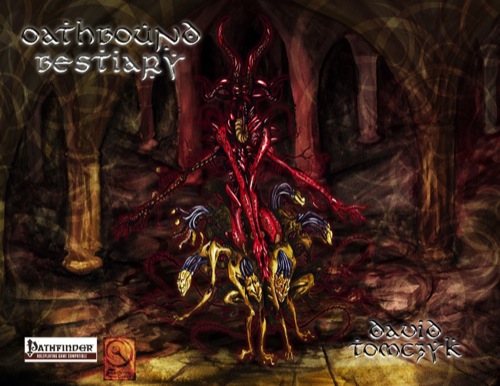
Editing and formatting has got to have been a herculean task for this huge tome of a campaign setting. To get it right, the tam of Epidemic Books must have invested a lot of time and effort, for right they got it. I noticed less than 5 formatting glitches over all the pages, weird choices like putting feat-prerequisites in italics not included. Layout adheres to a 2-column standard in full-color, with parchment-like background, tribal-like faded pastel-signs in the background and is in gorgeous, jaw-dropping full-color. The often organic, almost Gigeresque-looking artworks we know from Bastion Press have partially been used again, while in other instances, we are treated to true beauty: Some of the artworks here, rendered in what lacks like masterful works of water-color are so beautiful they could feature in an art gallery and render a instinct graphic identity to the setting that almost makes me wish the old artworks had been expunged from the book. The pdf, as is a must in such a massive tome of a book, is extensively bookmarked with nested bookmarks, though hyperlinks, which lately feature in a lot of releases, can't be found in these pages. If my raving and ranting was not ample clue:
Oathbound Seven is a GORGEOUS book indeed, but if you go only for the pdf (there's a POD for b/w (cheap) and full color (expensive)), be WARNED that there is no printer-friendly version. Printing out the whole book in full color killed a whole array of toner cartridges for me. As soon as I have the money, I'll cave in and get the full-color version.
Oathbound. The Forge. Perhaps one of the most unique settings ever devised for d20, with vast details, excellent writing, captivating metaplot - all updated for PFRPG, with glorious evolution-rules, updated races, new things that happened and SO MUCH CONTENT! Good content, actually. From the ideas present in Oathbound could have easily crafted 10, 20, perhaps even more campaign settings that would have felt more original than many out there. The setting is THAT rich in details, ideas and coolness, while never degrading into feeling incohesive. In fact, even though the Forge is an openly artificial world, it is more organic, more alive than so many worlds I've read about. Fantasy Authors out there should take a look at how world-building was handled here, for this is how it's done. Balance-wise, the options presented herein are all on the upper scale of power and when haphazardly introduced into a standard game, could wreak havoc. In their own world, though, they work and are balanced at the high end of the power scale that is the Forge. And with the advent of mythic rules right around the corner, I think enterprising GMs who don't want to check out the Forge will still find a treasure-trove of crunch, information and ideas here - especially when you're new to the Forge - this is the book to start your journey.
That being said, the TOME, as is wont with such an insanely huge setting (which is btw. insanely cheap for what it offers) has some flaws. Crunch-design wise, the skills still mention synergies, which should be eliminated. Class-design is perhaps the biggest offender: The linearity of the classes and PrCs just is disheartening, especially since they don't have dead levels and offer some tangible benefit at each level - with some options to actually chose from, the respective classes could, one and all, have become unanimously recommended pieces of awesomeness. What I'm trying to say is that they are good, but could have easily been excellent - channeling in particular feels like a massive chapter/capital idea trimmed down to its bare bones.
And then there's my grudge par excellence, my pet-peeve gripe in any conversion: No support for APG, Magus, et al. No archetypes, no teamwork feats, etc. Which is a HUGE wasted opportunity. Alchemists, Inquisitors (agents of the fowl?), Oracles, Cavaliers (weird mounts, baby!), Summoners - they all SCREAM Oathbound to me. Nothing. In order to truly go with the times Oathbound needs to embrace these new classes and I hope I'll get to see such a book in the future, wholly devoted to these.
So...How do you rate an extremely cheap iteration of a mind-blowingly excellent setting with stellar, captivating writing...that lacks a printer-friendly version and any support for APG, UM, UC etc. and massive balance-issues? Were I to rate this book sans context, just for its fluff and mechanical ideas (NOT executions!), I'd immediately slap 5 stars + seal of approval on it. I love this iteration of the setting more than its previous one. As a private person, I urge you to support this book so we get to see more of these awesome Oathbound books. As a reviewer, though, I can't rate this massive beast that high - the lack of a printer-friendly version, the lack of APG,UM and UC-support, the lack of new options that build decidedly on PFRPG-mechanics and the linear classes would usually mean that I'd bash this setting to smithereens. In fact, the race-balancing and the crunch generally is bad. The race-balancing, I'd even consider horrible, while several feats and components we are introduced to could worsen the problem. I'd usually crush this pdf.
Only that the classes are still great and the rules still solid and often times innovative. And the fluff.
Oathbound's setting is a bit like a good book - if you're like me, you'll start reading it and realize that it's morning when you alarm clock goes off. It is this attention to detail, this captivating prose, that, while the setting's not perfect, makes it impossible to rate this supremely innovative setting as mediocre. Thus, in spite of its glitches and flaws and due to the insanely low price (almost 500!!!! Pages for 10 bucks! In full color! With several full-page illustrations!) I'd recommend this immediately. Were it not for my function as a reviewer, which makes me feel only justified in giving this setting a final verdict of 3.5 Rudii, but WITH endzeitgeist seal of approval for the fluff and ideas. Crunch-hunters, dig elsewhere and buyers: Be aware of the power level and the amount of work you'll have to do - without it, your Oathbound game will suffer. Now let's hope for more Oathbound goodness in the future!
Endzeitgeist out.


 Posts
Posts