8.03.2012

EZG reviews Dark Roads and Golden Hells

Hej everybody,
today I'm going to take a look at the latest Open Design, in which we get to take a trip to planes both wondrous and wicked:

Dark Roads & Golden Hells
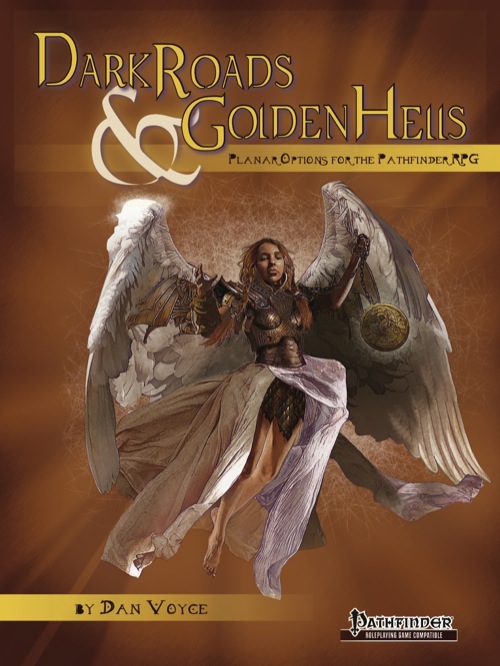


This pdf is 111 pages long, 1 page front cover, 1 page editorial, 1 page ToC, 1 page SRD and 1 page back cover, leaving a total of 106 pages of content, so let’s take a look!

Disclaimer: I was a patron of this project, but didn’t contribute due to time-concerns.

All right cutter, I see you’re rather clueless about them’s roads, so here’s the chant:

The pdf kicks off with a rather interesting treatise on the nature of planes, making the outer planes essentially a foundation spawned from the soul essence of beings, entwined with an ever-swelling tide of interlapping ideas that continuously touch, change and expand each other,  giving birth to countless, even infinite multitudes of ideas – to the point where infinity itself is just another idea betwixt an uncountable legion of concepts and their ever-soaring inhabitants, seeking for meaning – be it gods, outsiders or mortals. If one were to say so, even the phenomenon of quantum entanglements could be explained in the magical context of a planar game and fit within the themes that determine one’s after life – for as like draws to like, proximity destinies and karmic resonance are not just abstract concepts here and while numbers are present in many mystic traditions, it is in the planes that they exhibit their full potential and significance, just like abstractions and allegories may actually become truth and quite literal in the planar realms of countless possibilities. Even better, outsiders, those strange beings (and strange they should be due to their very nature) in service to a cause or concept, are also given a rather brilliant introduction, returning the concept of distinct foreignness that soften escapes DMs to these beings – immortal souls, player in the grandest game, these beings are different from mortals, even if they once were ones themselves.

In a total of 10 sample entries, we get a selection of outsider personalities, ideologies and character traits (not mechanical ones, mind you) that serve as a stellar gateway for any DM (or a brilliant primer for those characters with Knowledge(Religion) or (The Planes)) to outsider psychology (lacking a better term): From immortal chessmasters to cynics and elementals and whisperers, these write-ups immediately spell out evident truths and serve in a way that has largely been absent from many products – in just a paltry 2.5 pages, this pdf returns the “out-“to outsider: They are not us, they do not belong to us mortals. Granted, Paizo also does a great job regarding their outsiders, but seeing such an inspiring introduction to basic concepts is nevertheless awesome. And that was, as mentioned the introduction.

In chapter 2, we are introduced to the variant cosmology that serves as the default for the highly anticipated Midgard campaign setting, but with the general design-goal of remaining modular to the extreme and easy to plug and play into just about every kind of cosmology – from Planescape to the Great Beyond. Central concepts of the cosmology presented in these pages is a sense of an end to a cycl –just as once the primal gods were vanquished and banished from the worlds and planes, so is the fate of the new gods already woven, spinning towards Ragnarök in the ever-changing eternal game that fate and chance may play – or not. Generally, the addition of fortune and destiny to the cosmic forces at play as a dominant construct and concept feel like a very smart move indeed. The two dominant struggles in the planes Psycohmachia, the feud between good and evil for mortal souls as well as the eternal fractal dance of law and chaos are concepts introduced in lovingly unique detail and care. Of course, conceptual planes those touching upon the prime material plane are also a part of this chapter, as is an extensive discussion of how alignment traits of respective planar locations, be they overlaps or planes in their own right. The conceptual planes deserve special mention: From overlaps like mercy street, the lane of disguised celestials, to a city in which everything is mad of glyphs, both inhabitants and everything beyond to the palace where all things lost and broken go – these locations ooze imagination and creative sparks and may, very well, spark their own multiverses, campaigns and concepts, as befitting of the uncounted possibilities inherent in the planes. Better yet, the planes adhering to the order of elemental indwellings also are featured and come with a rather staggering array of sample locations – from 999 Luftballoons, inhabited by intelligent wasps to the forests of valor, where burning, fire-clad celestials stoke the fires of courage in mortal souls.

Even better – from the elflands, home to inscrutable beings like the Ljósalfar and similar mysterious fey to the loom – the planar fabric that connects the grand tapestry to the far beyond at the edge of conception – both planar frontier, edge of infinity, liaison to unimaginable things and distortions to the 7 heavens of the cardinal virtues to the eleven hells as well as the shadow realms, home to the courts of enigmatic shadow fey and other things strange and unimaginable, the compelling cosmology of Midgard is concise, expertly presented, stellar in imaginative quality and missing in no virtue to be expected from such a sourcebook. Add to that the Underworld, a dark prison of Carcerian dimensions in which liches and yama-kings decide on reincarnation all sorts of bleakness and desolate things abound and suffuse that with the staggering amount of sample locations, each of which could spring-board one, if not a vast array of campaigns, and we’re in for one of the coolest cosmologies I’ve read since taking in the original conception of the great wheel and all the derivative systems that spawned from it. Suffice to say, I consider this cosmology on par with, depending on your tastes perhaps even better, than Paizo’s and their version of the great wheel and Golarion’s tradition-infused, yet fresh take on the old tropes has been so far my favorite one since the inception of Planescape in second edition. And yes, that does include just about all 3pps and books like “Beyond countless Doorways” for 3.X.

Oh, but that’s not all! There also is a chapter that begins, quite titillating with: “Between”.  After the grand overview, we thus delve into the samples for the strange places that can be found beyond the boundaries of mortal perception and the first location we’re introduced thusly is quite literally “Between” -  the place where all those teleportation mishaps and plane shifting accidents alongside all the lost things, broken and abandoned, end up to form a  plane coalesced and defined by a sense of not-belonging, by a sense of unbelonging and hybridity and the malevolent intellect of the intangible form that acts as master, creator and abductor – the Limnus.  It should be noted that not only are the mechanical repercussions of such a plane are covered, but that magical peculiarities, denizens and adventure seeds are a part of this and all the entries that follow. Second is the Casino – another place between extremes, this place could be seen as the nexus between fate and chance, between law and chaos and is thus also headed dual thrones of law and chaos, this is the place where kingdoms and yes, even worlds and souls can be won, where fortunes are squandered and gained and where pachinko and signal noise games await alongside the options to gamble with the best the planes have to offer – but remember the ultimate truism of gambling – in the end, the house always wins…

After a trip to the dangerously joyful casino, we delve into the depths beyond and visit a particular corner of hell: Evermaw, where all things starve and thirst and Mordiggian the Hunger God rules beneath jaundiced clouds and even the mighty Ever River is but a mere trickle: Here, Mordiggian’s spawn, the ghouls and vampires rule and it is here the erstwhile lieutenant of Orcus has retreated for now, content with his living ghoul servitors and plotting towards inscrutable goals, the grand city (though grand may be a misleading moniker) “Beyond Vultures” offering multiple hooks and a disturbing peculiarity: The lottery. Worse than in Panem, the lottery brands each person with a 4-digit number once it has interacted and bought something from a resident – subsequently, each day means that the number may be drawn. If it is, the city demands a toll that is to be paid in flesh…

Now, if you’re looking to buy something truly out of the ordinary, there’s no place but one –marketplace. Literally THE marketplace among the vast planes, it is here that just about anything conceivable can be bought and sold – from hope to classics like Angel’s Tears or even the broken hearts of demons, this city can probably best be described as the planar consequence of mercantilism beyond moral boundaries, somewhat akin to a bigger brother to Katapesh and all who have visited that town in Golarion can probably depict how an escalation of this concept may look like. Better yet, the creatures provided as sample denizens include far-out characters like a suave mimic-master spy/sheriff that serve to add a plethora of style to a given rendition of this trade-hub among trade-hubs.

Now, the Plane of Spears is something different altogether – remember that concept of Valhalla, fighting only to be renewed and fight again? The Plane of Spears is essentially that, minus the feasting and anything resembling a respite from a battle neverending. Now, If you think that the place remains in static conflict, you’d be wrong, though – the battles fought and lost, the places conquered and sacked actually change the plane towards some inscrutable destination in the eternal game between destiny and fate. Beyond the bloodshed and the violence, though, glory, riches and prowess beckon and worst (or best) of all: Newcomers may easily be doomed by dying to remain here – for all eternity to wage wars and challenge the armies of gods, demons and things beyond mortal ken.

Particularly interesting in its implementation of the concept of the fractal dance would the be the domain of Rusty Gears – set in Rava’s realm, the perfectly grinding gears and clockwork-realms work in perfect precision, inevitable roam – but where’s law, there’s also chaos – fields of rusts, towns constructed on moving gears and vast junkyards of broken cogs await those eager to find fate’s destination for them or an opportunity to jam a wrench into at least a part of the grand machine. Since it’s no secret that I am a huge fan of Mechanus and its mechanical inhabitants, you can imagine my delight when reading this particular section. And finally, there’s the Well spring of Life and Radiance: Here, Potential, essences and minds spring forth is blazing glory and sefirots to enlightenment await – if you brave their dangers, these literal and metaphysical paths enable you to gain a unique power (temporarily or permanently) and gain access to certain planes. Beware, though: For many have found truths that burnt them and destroyed them. I love this plane for its clever links to mysticism and metaphorical concepts as well as the dominant idea of radiance as something amoral and generally considered “good” that can nevertheless destroy the imperfect mortal as any kind of similarly pure cosmic revelation, thus somewhat further diluting the bland diametric oppositions that make gaming often so predictable.

Of course, there also are some major new pieces of crunch here for your perusal, starting with 3 new races: From Devas, born of the stuff of raw creation by echoes of personalities in the plane of radiance, these beings can come with wings, multiple arms or even bestial or elemental essences. They also are the only race that could lead to some abuse – I am not and probably will never be comfortable with playable races that (can) have more than 2 arms and not off some kind of inherent drawback. The Maxims and Warptouched are two sides of the same coin – the one touched by law, the other by chaos, with fitting racial abilities for both – I didn’t have anything to complain about either. Unless I’ve miscounted, we also get 45 new feats, which is slightly more than  I would have wanted, seeing the potential for feat-inflation. However, even in this section can we find some rather interesting ones – from a feat that makes you immune to the modification of memory (think about it – no one but you remembers: What a great plot-device!) to the new concept of patronage feats that require you to be in service of a concept, god, deity etc. and clearly marks you, but also provides some nifty benefit, the section can be called well-made indeed. More than 40 new traits also draw on the new planes and planar concepts expounded in the beginning and some of them actually are fun: You could e.g. take “Lucky number”. Roll 1d20 at the campaign’s beginning – that’s your lucky number and every time you roll it on a skill-check or atk-roll, you gain a bonus of +1. Neat idea!

Now, it’s no secret that I LOVE the concept of Incantations (and if you haven’t bought the Zombie Sky Books yet, go do so now…) and thus, I was rather happy to see 2 new incantations herein – one to stand on the dead man’s bridge and bargain yourself into the underworld (but not necessarily out…) and oneto pass from the prime material to the elflands (or the shadowplane, depending on cosmology, I guess), but only by utilizing a site of tragedy and death. I LOVE these and I honestly would love for a whole book (100+ pages) of incantations of a similar quality. And then there are the 18 new spells and oh boy, they are…AWESOME. Again. Yeah, I know, broken record… But seriously – with the spell “Slipstream”, you can tag on to other creature’s teleports and come out close to their destinations. And then there’s “Defensive Paradox”, which is a stellar spell to negate devastating attacks, but which may change you forever and replace you with an alternate version, essentially allowing you to change afflicted character’s personality, Dr.Who-style. Alternately, you could use your magically enhanced sense of combat geometry to make truly devastating ricochets and similar supra-genius attacks. Hell yes!

Chapter 5 then deals with advice on gamemastering the infinite planes and if you expect tried and boring truisms, you’ll be disappointed: Instead you get poignant, sound advice on how to do it as well as ANOTHER selection of awesome locations – gateways to the planes, from the feyroads to the 9 Stairways, the house of infinite doors and the ever river to the road of gateways, we get a neat selection of traveling ways beyond boring spells that should satisfy all tastes. Better yet, planar settlements and settlement-modifiers (including disadvantages), sample fully stated planar settlements, again, with excellent fluff (and statblocks) are fully detailed. However, in the planar economies-section, the book once again amps up the coolness: From buying and selling (or loaning) your body, the purchase of destiny, names, youth and voices and similar esoteric goods are covered. And there are rules for the archetypical sword, the flesh of fate-eaters and remnant pearls, remains of squashed planes – all artifacts, mind you.

The final chapter details the bestiary and kicks off with new templates: From the Animus, to the fallen/risen templates to the servants of death (Ankou, CR +1) and the radiant creatures to those called neverborn, I enjoyed the templates. The first new creature is the Algorith, an angel of force, pure math, universal physics and impeccable guards against things that none should know or witness. Fidele Angels are more benevolent: Born from a love so pure it transcends death, they retain their memory to guard their mortal lovers. Perhaps against the threats like the Cambium, which seek to steal the mortal creatures humors – a great call-back to this pseudo-medical concept, which imho should see more support in the game. Also rather disturbing, the fate-eaters may unhinge certain abilities and devour not only a mortal, but also his/her/its abilities, skills and feats. The idiot-savants of chaos, the headless hundun are creatures of creation and might seem almost chthonic, though they remain a general brainless benevolence. We also are introduced to clockwork dogs, rust drakes and eyeball-like observers, to finally the spinning hags, which could essentially be pictured as lesser versions of the Norns with some cool additional abilities. All the creatures herein come with a multitude of signature abilities and the b/w-artworks are fitting, where provided.

Conclusion:

Editing and formatting are top-notch, I didn’t notice any significant glitches while skimming through the pages of this pdf – great to see that the somewhat major editing glitches that plagued some ODs have been purged from these pages. Layout adheres to a 2-column standard and is mostly black and white, accentuated with an elegant gold that should provide a great synthesis between good looks and printer-friendliness – kudos to layout-artist Marc Radle. The artworks contained herein are b/w, adhere to a rather nice style and can be considered top-quality as well. The pdf is also excessively bookmarked.

All right, I’ll say it straight away: When Dan Voyce, lead designer of Northlands announced he would head the planar sourcebook for Midgard, I knew that this would rock in the end. Little did I know how much not only Dan, but also the patrons understood the peculiarities that make the planes different from the prime. In no way did this book ever amount to the rehash of a prime material concept, instead providing not only a strikingly original cosmology, but also featuring a splendid array of locations and creative ideas that can enhance your game, even f you already use other cosmologies: The ease of plug-and-playing any component of this book is beyond belief and in fact, in my opinion, the crowning achievement: While the content herein could stand alone as a cosmology, whether Planescape or the Great Beyond are used – all components retain their usablility without losing their conceptual identity, thus making this book, at least in my opinion, vastly superior to all 3.X-plane-books. And yes, that does include the otherwise awesome “Beyond Countless Doorways”.  I’ve been waiting for such a book since Planescape and the only other planar resource I could mention that somewhat is similar in quality, though different in focus, would be Paizo’s. Yes. It’s that good – and it’s also intelligent. I only touched upon all the awesome concepts herein, briefly even and delivered only a fraction of potential interpretations. This book can enrich any campaign and even if you don’t want to go planar (yet), I guarantee that the content in this book and its ideas can influence any campaign in some kind of positive way. And even the crunch (of which I’m not as big a fan – I can’t see those boring traits anymore…) has its stellar quality, from the cool patronage feats to the excellent spells and incantations, we’re in for fun galore. My final verdict, if my rather lengthy tirade of joy and praise has been no indicator, will be 5 Rudii + seal of approval. 


But wait, there's more!


Shadow Planes & Pocket Worlds


This web-enhancement to "Dark Roads and Golden Hells" is 25 pages long, 1 page front cover, 1 page editorial, 1 page ToC/introduction, 1 page SRD, leaving 21 pages of content, so let's check this out!

This pdf kicks off with a controversial domain - Mora, The Children's Table has, according to the introduction, actually made a patron quit his patronage of the project. Born from the remains of a celestial mother figure that devoured instead of nurture. Thus, today the island is haunted by memoriasma, a deadly mist that might catch you in a perpetual nightmare and the inhabitants are not better - parasitic vampyric dryads, boogeyman and all things abominable that may haunt childhoods and be considered darkest possible representations of the worst fears. Mora is a dark and twisted place, somewhere between fairy tale and hell, twisted and tainted, vile even, but is it tasteless or particularly explicit? Not in my opinion. Personally I loved this twisted realm and don't get what's particularly offending about it, but I guess for some people, the theme of the realm might hit a bit close to home. Mora is definitely not a place that should be introduced into a campaign featuring kids, but for mature or adolescent players and GMs, a vast wealth of twisted imagery can be found here.

After that, we are get the fluffy story to supplement Rusty Gears, the tale of Arachne and Charun and after that we get a selection of planar hazards, traps and afflictions: From Alephs, chaotic motes of planar conjunctions to non-euclidian angles to flowers that can hasten you, but age you and may enable you to relive memories, we are in for quite some awesome hazards. Better yet, the Ever River also gets its hazards, from Phlegethon to Styx and Lethe, Gjoll and Acheron, the write-ups rock.

6 new planar diseases and 7 planar drugs and poisons (including Angel's Tears and Lethean Ale) are also part of the deal, as is something utterly awesome: 7 different kinds of planar effects - from xaosiana, an insanity inflicted by prolonged contact with  chaotic planes to temporal distortions between planes - stellar!

We also get an infinite pit trap, stats for the food of the dead, the fractal shield ability and the impossible weapon quality to 12 new excellent magic items, this section of the pdf once again can adhere to the highest standards - from the egg of the world to faerie food, the items are not only cool, they evoke a sense of wonder.

The pdf also provides a bestiary that kicks off with two different templates: The imaginary friends (CR +2)of those damned on Mora and the She-template for the dark female masters of the land (CR +2) are included and then there are new monsters: The CR 12 legendary Arachne, who is on a never-ending quest to replace Ariadne as the weaver of fate gets her stats, as does the narrator of the books, Cicerone the Upfallen, a fallen deva bard (CR 19) as well as the beautiful, deadly angel of revenge, Lady Liliam the Black Avenger (CR 14) complete the additional information contained herein for the stellar "Dark Roads and Golden Hells".

Conclusion:
Editing and formatting are top-notch, I didn't notice any glitches. Layout adheres to the same beautiful 2-column standard of "Dark Roads & Golden Hells". The pdf has no bookmarks, which is a pity, but comes with quite an impressive array of beautiful original b/w-artworks I didn't expect to find here - Kudos!

Let me come right out and say it: If you only slightly enjoyed "Dark Roads and Golden Hells", you definitely need this. If you're looking for a smörgÃ¥sbord of planar options to add to your campaign and don't plan to use DR & GH, you may still want to check this out. Why? Because it's probably the highest quality content you'll find for such a  low price. This pdf is a stellar example of writing, of crunch-design and fluff-writing and is completely on par with the main book, which ranks imho among the best planar sourcebooks ever penned. My final verdict will thus, of course, be a full 5 stars + endzeitgeist seal of approval.


As always, thank you for reading my ramblings,


Endzeitgeist out.

7.30.2012

EZG reviews Rituals of Choice II

Hej everybody,

after taking a look at "A Witch's Choice", you probably knew that it wouldn't take me long to go after its sequel and thus, here we are again with a modern classic of adventure writing

Rituals of Choice II - To Kill or Not to Kill


This adventure is 46 pages long, 1 page front cover, 1 page editorial, 1 page SRD and 1 page back cover, leaving a total of 42 pages of content, so let's check this out!

This is my second review of one of Rite's excellent Arcana Evolved adventures, which I'll also review with specific consideration for the PFRPG-audience. Thus, this review contains SPOILERS. Potential players might wish to jump to the conclusion, while idea-starved GMs are very heartily encouraged to keep reading!

All right, still here? Good! Claiming their deed for Plungedeep Manor after the first module, the PCs return to town after experiencing a staggering array of choices and omens in part I. Even if you want to play this module as stand-alone, you'll be provided quite a bunch of different adventure hooks - 10 to be precise and all of them go beyond the standard.

Following the theme of dreams, the golden jackal returns in a dream and points the PCs towards a murder most foul  - by being pounced and dream-dying - it is this attack that delivers the first clues to solving the complex mystery underlining the plot of this module. The Catchpole of the village of Far-Rough, Gavel Taverson, a Totem-Warrior (could easily be substituted for an animal-focused ranger/druid, btw.!), is investigating two recent murders and is fearing that a rune-marked sacred grave talon called Solange might be responsible, which is doubly problematic since that happens to be Gavel's totem. Worse yet, Gavel might actually be the first suspect as a totem warrior - shapechanging, sickles - has he gone off the deep end? Things get worse, when the PCs find the remains of visiting nobles and tracks of a grynloc-child. Breandra Neverhold, the ostrich-riding faen-woman (fey-like creatures) and daughter of the first murder-victim should be among the PC's first addresses.  For a GMs convenience in running the murder mystery, each of the Npcs has extensive information on them, concisely presented, summing up what would make them suspicious, which clues to the puzzle at hand they can deliver etc. - means, motive, opportunity, all bases covered. Lord Golhia and the other Npcs don't make things easy for snooping PCs, as many secret allegiances want to be kept silent by their respective owners. Fret not, though: If the PCs get stumped a dreamhunter named "Rosie" will help them track the killer and the lead points toward the eerie floating forest where, on a vast tree fallen between waterfalls, they will have to negotiate with a deadly balde-troll and his giant hornet-riding goblin henchmen Once the PCs have crossed this bridge, they may encounter the caves of the greenbound Qwayneel, where they can extract a dread parasite from an animal and encounter e.g. the potentially lethal bone vipers.

The true conundrum is laid bare, though: Faced with overwhelming proof, Gavel is on the way to end his career as a totem warrior - while the greenbound wants the PCs to refrain from attacking Solange and instead hear the intelligent, rune-marked animal out. It turns out that the deaths of the nobles can indeed be attributed to the sacred beast, but the death of e.g. the children are not Solange's doing - these can be attributed to another Deinonychus, one infused with the power of 3 dread runes - depending on the  job the PCs have done while investigating the crimes, they make actually take the work off this beats, witness the fall of a totem warrior and death of a sacred runemarked creature or something completely different - they have the option to kill or not to kill: Every creature in the module.

The pdf closes with appendices detailing the Deinonychus Totem Warrior, 2 new feats, 1 new spell, 2 new templates and 10 magic items, all with extensive Akashic lore-sight information.

Conclusion:
Editing and formatting are top-notch, I didn't notice any glitches. Layout adheres to a beautiful, full-color 2-column standard with brilliant full-color artworks and awesome maps by Jonathan Roberts. The pdf comes fully bookmarked.

"To kill or not to kill" had not been nominated for an Ennie for nothing: This module is a joy to behold with an interesting murder mystery that is easy to run, challenging, does not succumb to overtly generalizing b/w-dichotomies and feels logical. Better yet, the respective characters ooze iconicity, the emphasis on choice between life and death, violent and non-violent solutions and the smart usage of dreams as hints make this module an absolute delight to read, while sacrificing none of its predecessor's awesome, dream-like quality to its usability. Indeed, I maintain that with a  minimum of work, just about any DM can convert this module to PFRPG and enjoy one of the best murder mysteries out there. Even if you don't want to check out the "Rituals of Choice", even if you play PFRPG and not Arcana Evolved, this module still will be a blast to read and run - try as I might, even if you take the time it takes to do a conversion into account, this pdf remains a superior example of adventure-craft and writing and even for PFRPG-DMs, this should be considered a straight 5 Rudii-recommendation, + seal of approval. If you haven't already, go check it out - this is one of the modules that will be considered a "hidden gem" in the years to come.


All right, that's it for now - next time, I'll have a current book and a true gem for you - 
as always, thank you for reading my ramblings!


Endzeitgeist out.

7.25.2012

EZG reviews the Terrain Toolbox

Hej everybody,

today I'm taking a look at one ennie-nominated product, Sneak Attack Press'

Advanced Encounters: Terrain Toolbox


This pdf is 32 pages long, 1 page front cover, 1 page editorial, 1 page ToC, 1 page advertisement and 1 page SRD, leaving 27 pages of content, so let's check this out!

First, you'll have to indulge in a little bit of vanity on my part - I joined the kickstarter for alternate objectives and the rapier-wielding guy on the walkway across lava in the first piece of b/w-artwork? Well, that's me. Great rendition and rather close to the original, if I may say so. That piece of idle ego of yours truly out of the way, let's see whether this toolkit lives up to my steep expectations. So what exactly does this provide?

This pdf is essentially a DM's toolkit to making the terrain count in your encounters and thus starts with a discussion of different effects of terrain - from obstructions, to movement-altering properties,  damaging, healing and even boon-granting terrain-types are mentioned. Next, options to change the terrain are covered - from activating terrain to one that can be destroyed and triggered ad then even moving terrain is covered - as is portable and spreading terrain. Special mention deserves the massive table on terrain damage by level and DCs, making the rafting of your very own damaging terrain easy indeed and just a matter of taking a single glance.

These basic concepts and discussions out of the way, we take a look at different terrain special abilities and oh boy, the list is neat: From Acid Rain to an Arcane Ballista, we're in for fun: Placing and using the respective terrain pieces is easy and we're in for a neat design decision: The terrains use their own atk-bonus in order to enable the maximum number of PCs to use them, but also provides guidelines to enable you as a DM to use the PC's capabilities when utilizing terrain. But hat's not all - the Blood Mage's Circle lets PCs sacrifice HP for empowered magic, while chaos motes can deals random energy damage and spirit circles can make incorporeal spirits corporeal. Add conveyor belts, crumbling walls and dimensional rifts that teleport people entering them, add exploding kegs, swamps erupting in flames,  jump-pad like stones that let you temporarily fly, floating stones, floors sans friction, giant cogs to make clocktower battle-scenes, grasping zombie claws from the floor, divine blood, variations of holy light/gloom, flammable oil, and lifting pillars (including a special maneuver to have foes attack the pillar, potentially collapsing it) up to mine cart rides, deadly mushrooms and even shattering glass, we are in for a wild ride.

Have I mentioned sleep poppies and the river of dreams and the ability to proverbially draw the weapon of kings, Excalibur-style, from the stone? What about more standard spiked floors, tugging rugs from under the feet of opponents, weak floors, trick staircases and even the option to treat walls and ceiling as ground, making battles 3-dimensional -awesome!

The pdf concludes with a list of terrains by location.

Conclusion:
Editing and formatting are very good, I didn't notice any significant glitches. Layout adheres to a 2-column b/w-standard with some neat pieces of b/w-artworks. The pdf has no bookmarks, which is a bummer, as it impedes the otherwise stellar usability of the pdf. That being said, you should print out this pdf anyways - this toolbox of awesome terrain features is a GODSEND to DMs.

To all DMs of 3.5 and Pathfinder, to everyone sick and tired of boring encounters, to every DM out there that seeks to add spice to his encounters, to any group out there: If you're tired of encounters being just about the same types of terrain, about the same weather and combat options, this is the end to your woes. Humble to the extreme, the Terrain Toolbox is simply one of the best and most useful DM-tools released so far for PFRPG and BELONGS into any DM's arsenal. The guidelines towards the creation of your own terrain complement the stellar examples of cool options to spice up your encounters and the fun truly begins once you start to combine the features - flight stones, thought floors and perhaps a chaos mote or two and we're in for an otherwise unremarkable encounter turned into a mind-boggling experience guaranteed to have your players talking about the battle for years to come.

A dungeon created with this book will be almost guaranteed to be vastly superior to one created sans this pdf.  Add to that the low price and we have a pdf that you definitely have no reason whatsoever not to purchase. In fact, I'd urge Paizo, if/when they ever create a second GM-guide to create a chapter devoted to such terrain features. Yes. It's that good. I rarely encounter a pdf I can so universally recommend to just about all GMs out there and remain only with two complaints - first, the lack of bookmarks SUCKS. Especially for such a useful product that will see a lot of use. Secondly, I so would have wanted this pdf to be triple the length - we need sequels. Seeing how one complaint isn't enough to rate this down, I'll remain with a final verdict of 5 Rudii, but withhold my seal of approval until bookmarks have been added. That being said: Get this. Seriously. You won't regret it.


All right, that's it for now, as always, thank you for reading my ramblings,

Endzeitgeist out.

7.18.2012

EZG reviews Rituals of Choice I

Hej everybody,

today I'm going to take a look at a modern classic in adventure writing, at least in my humble opinion. Although the following module is made for the Arcana Evolved ruleset, I encourage all 3.5 and PFRPG-GMs to still read on - you'll soon see why!

Rituals of Choice I - A Witch's Choice


This pdf is 46 pages long, 1 page front cover, 1 page editorial, 1 page SRD and 1 page back cover, leaving 42 pages of content, so let's check this one out!

I've been wanting to review this module and its sequel for quite some time now and I finally felt like it was not only an option, but something I had to do now. So what exactly is the "Rituals of Choice"-AP? Essentially, it is Rite Publishing's patronage-based AP set in Monte Cook's Arcana Evolved setting of the Diamond Throne. If you happen to not be familiar with this d20-variant and its peculiarities: The Diamond Throne-setting is unconventional fantasy to say the least. The lands of the Diamond Throne feature not only different base-classes, but also little fey-like PC-races, lion-humanoids and genderless, immortal reptilian creatures that can be considered the heirs of the dragons. Moreover, the setting emphasizes personal choice over predestination and mortal heroics over plans of strange entities. Furthermore, the setting is one of grey morality, featuring no clear-cut good-evil distinction and no alignment per se and several unique ideas, like the Akashic's, individuals that can tap into the collective unconsciousness of the world and thus unearth information about magic items, individuals  etc.. It should also be noted that AE's basic ideas have probably featured at least somewhat prominently in the development of Pathfinder and, admittedly, while I loved many of the rules, I never really got into the Diamond Throne-setting. When I got my hands on this module, though, things changed, but now that the intro is out of the way, I'm going to delve into

SPOILER-territory. Potential players might wish to jump to the conclusion.

Still here? All right! Before the Pathfinder-APs did so, this adventure starts with integrated reasons for the PCs to adventure. These reasons can be considered a kind of combined hook/early trait-system, but is based on the whole group! And then, right off the bat, you'll realize why this adventure gets my attention: The very first scene. On a balcony of glass, a female Verrik (a magical/psionic race with a terrible racial curse) is unleashing deadly magical powers on a golden jackal and the PCs, while muttering excuses for her behavior. The Verrik witch vastly outclasses the PCs, but they may yet prevail...and arise from the strange dream - an epic battle as a great in medias res introduction to the central figure of this first adventure:

Immensely talented, Zewthra's powers killed once a Litorian and in order to not hurt anyone with her gifts, she chose to seal her powers. This act, though, combined with the Verrik's racial curse, has led to a severe case of Autism on behalf of Zewthra. Her father, the aristocrat Vethkar, is unfortunately old and dying and his daughters latent powers have gathered the PCs here, in the town of Far-rough at the edge of the floating forest. The old man is concerned about Zewthra and wants her escorted to a mystic side called Tesham's Landing to perform a ritual. It is also here, that a peculiar magical item is introduced, which enables non-akashics to delve into the collective unconscious and gather information if such a class is absent from the group.

If the PCs concede with the escort mission, they will embark as soon as possible. On the way, though, a downpour will have them stranded on a floating island and there, spined grapplers will make for the first danger to avert and the first choice, for the creatures have laid eggs - the destruction or preservation of these unborn a symbolic foreshadowing of the choices to come. More interesting, extensive information on the ritualistic behavior that allows Zewthra to function and is necessary for her is detailed extensively.

Things start to become rather grim soon afterwards - the group is attacked by Staj, eye-extracting predators and might also make for the death of Vethkar - the man will not see the end of the journey after losing two eyes and Zewthra will also be mutilated, but not overtly concerned by it.

And then there's The Kallethan - 6 undead dragons bound into one human skeleton, one of the most powerful entities in existence (CR 28) - and it is helpless at the PC's mercy. It can be captured via magical shackles. It can be left to its fate. It can be healed. And the PC's action will have very significant consequences in the things to come.

The PCs seem to have stumbled into historical events and indeed, even the centaur and his mojh travel companion they meet (the former taking a fancy to Zewthra) and their interactions will have repercussions - though not ones as significant as the encounter with Amoncirith, the messianic son of god among dragonkind and his guardsmen.

And then, there's the first encounter with a rune-animal Deinonychus named Solange, which will feature more prominently in the second module - whether the PCs manage to save the dinosaur's noblewoman prey or not - consequences again are sure to surface along the line.

In the Mire of lost souls, a will-o'-wisp, unable to communicate wants the PCs to find its body and bury it, which might provide to lead them into conflict with the local muckdwellers and then, finally, the PCs reach the leafless wood, where Witchravens misunderstanding the situation, might attack the PCs and the ritual will commence - if the PCs manage to coax her into performing it. Said ritual comes with full in-game information and seems to make for an interesting climax, as aforementioned centaur returns with allies to make Zewthra part of his harem. If successful, all witching sites will be linked and Zewthra cured of her autism and the PCs will just have inherited  Vethkar's mansion and put in my motion a chain of events that will resonate throughout all of creation.

The pdf also provides appendices with suggested secret magic items - a total of 9 are included and each item gets 10 pieces of information for purpose of akashic loresight - very nice! The appendices also include the new Kismet witch and the cursed spirit creature template.

Conclusion:
Editing and formatting are top-notch, I didn't notice any glitches. Layout adheres to a BEAUTIFUL 2-column, full-color standard and the pieces of full-color, original artwork are awesome! The pdf comes fully bookmarked and 5 (!!!!) labeled and unlabeled maps by Jonathan Roberts, which are not only included in the pdf, but also in special high-res packs. Oh, and they, even among Jonathan's excellent oeuvre, belong to his best pieces in my humble opinion.

On the surface, this module feels like a rather straight escort-mission, an overland journey, but, and I don't say that lightly, "A Witches Choice" is probably as close to art as an adventure can be. Unobtrusive symbolism, foreshadowing, helpful designer's notes and a caring, sympathetic and mature take on autism and the freedom of choice as well as the philosophic questions raised by a shades of grey-mentality conspire to create not only a great module, but a unique experience. And then, there's the immediate sense of epicness pervading the whole storyline. While at this moment, it is not sure whether we'll see the whole AP completed, I do think that most PFRPG-DMs can use this module and scavenge parts. While straight conversion might provide difficult due to the peculiarities of both the setting and the classes, I maintain that there's an easy way to utilize the material even in a PFRPG -game: Make this whole module a kind of dream, or even just scavenge some parts. hell, I'm convinced that a GM who checks this out can learn quite a bit about effective foreshadowing and adventure-crafting. And there are the stellar maps. This module makes me realize once again how much I crave more adventures of this top-notch quality penned by Steven D. Russell, who has created a thoroughly original, awesome adventure oozing passion. My final verdict will be 5 Rudii + endzeitgeist seal of approval.


All right, that's it for now, next time I'll have a more recent release for you!


As always, thank you for reading my ramblings,


Endzeitgeist out.

7.14.2012

EZG reviews the Cloven Hoof Snydicate

Hej everybody,

today I'm going to take a look at Clockwork Gnome's latest pdf

The Cloven Hoof Syndicate


This pdf is 45 pages long, 1 page front cover, 1 page editorial, 1 page ToC/SRD, 1 page back cover, leaving us with a total of a whopping 41 pages of content, so let's check this out!

The pdf kicks off by announcing its intent, which essentially is bringing a new and sinister twist to the old trope of the thieves' guild and then goes on to introduce us to the presumed default setting of Eorthe, the world of CGP. However, you should be aware that the content herein can easily be transported to just about any setting and is in no way too tied to campaign setting specific tropes. Aerendal, City of viridian princes, built upon 6 rocky islands, connected via bridges, makes for the default and we get a whole page describing the city, including a broad over-view map with color-coded districts. I hope we'll one day see an extensive gazetteer including excessively detailed maps on what could become a Venice-style den-of-sin metropolis and intriguing setting extraordinaire.

The Cloven Hoof Syndicate is an interesting organization not only because of its extensive history - reaching back towards a planar event involving Faerie and the realm of Abaddon, the syndicate and its twisted members are detailed in excruciating detail. To be more precise: From smuggling, to drug-dealing and prostitution, the kraken-like tendrils of the syndicate reach into all spheres of illegitimate businesses and describe the methods of the syndicate and its means to avoid detection in detail. Better yet, sample incidents involving key-members of the syndicate's operations are covered and, along-side interspersed seeds of crunch like a new drug etc. serve to paint a tapestry of sin most foul and subtle that not only makes the organization a believable threat, but also makes it clear that the paranoia necessary to uncover its operations will border on the insane, limiting (apart from the blackmailed officials) the options of prospective PCs even further and making this conspiracy a threat that is most definitely not to be trifled with unprepared - their capabilities to create so-called Star-motes, "gems" (complete with rules)with a more sinister origin, is also testament of this.

Of course, no organization can live only from a stellar frame narrative prefacing each chapter or the excellent description of the operations -it needs people to conduct said endeavors. From rank-and-file members (CR 2) to high-level assassins (CR 9), we get a selection of 6 sample statblocks before we get to know them also fully-stated key-members of the syndicate, from its instigator and commander-in-chief , who is a challenge rating 16 brute and comes not only with a full statblock and more than one page of concisely-written prose, to a half-orc brute and the mistress of the prostitution-racket as well as the insane derro alchemist (including 2 new alchemist discoveries) that refers to himself in the plural majestatis (or has MPD) to smugglers that not only are dark creepers, but also carry a cursed taint, the key-members all provide interesting statblocks, entwines, cool narratives and perform key-functions in the smooth running of the syndicate. Have I mentioned the rakshasa-blooded skeletal champion (magus) rogue/sorceress or the tainted nixie bard? You get the idea - the key-members of the syndicate are not only dastardly villains, they are truly intriguing characters of their own right and can play in the upper echelons of cool builds, their abilities reflecting well their status and role in the organization.

Even better, the two level-base of the syndicates operation, the halls of abandon, are portayed in excruciating detail as well, providing a cool location and a neat potential for an "into-the-lion's-den"-type scenario or even as a base that can be established for the underworld contacts of the PCs, slowly sowing seeds of the conspiracy...

Conclusion:
Editing and formatting are very good, though not perfect - I encountered some minor typos in the text. Layout adheres to a greenish-tinted parchment look and the 2-column standard and the full-color artworks are nice: While city-scapes feature an almost impressionism-style standard and transport the taint well, most of the characters come with artworks I've seen before in other publications.  The pdf comes fully bookmarked (though I would have enjoyed nested bookmarks for the statblocks) and with a printer-friendly b/w-version. This version, while art-free, has only removed the pieces of artwork, resulting in odd blank spaces in this version of the pdf -reformatting the text in order to save more space would have been the more prudent thing to do here. The cartography is excellent and while letters denote the functions of each room, as a DM you could hand out the maps to the players as is. The pdf comes with full herolab-support.

Clockwork Gnome Publishing as a company so far does not have a steady output, but oh boy, when they do release something, I look forward to it - after their last offering on the maggot god Morithal became my new benchmark for what to expect of cults and religion-write-ups, the Cloven Hood Syndicate by author Paris Crenshaw seeks to establish a new default of what to expect of conspiracies and secret societies - and let me assure you, this syndicate is not another tiefling organization, but something much more sinister - so sinister in fact, that they might make great replacements of e.g. Zobeck's Cloven Nine or similar guilds. The prose in this supplement is of a quality scarcely seen in rpg-products and makes the reading of the pdf an actual joy to do rather than a chore and the frame narrative of an increasingly alienated and desperate investigator also helps to convey a sense of the depth of this particular rabbit hole. Better yet, there are numerous side-bar, should you be so inclined, to inform you about CGP's upcoming world and some peculiarities regarding e.g. ethnicities. That being said, this pdf unfortunately is not perfect: There are some minor editing glitches and I would have loved to get a map of the stunningly enticing default city in which the syndicate is set. Furthermore, the sloppy b/w-version is a disgrace to the quality of an otherwise stellar offering. HOWEVER, even with these blemishes, I can't bring myself to rating this book low - I've read a lot of tribes/secret society sourcebooks and for the low price, this is definitely one of the best. Hence, I'm going to do something I seldom do - I'll rate this 4.5 Rudii and still award the endzeitgeist seal of approval. I urge you strongly to check this out and hope the printer-friendly version will be revised to reflect the quality of the full color pdf.


All right, that's it for now - as always, thank you for reading my ramblings,


Endzeitgeist out.